Good Whop membership tiers separate meaningful benefits that buyers can understand. Start with an access matrix and a delivery-capacity check. Three differently named versions of the same vague offer usually make the choice harder.
Disclosure: AdsX owner Dennis Hegstad is employed at Whop. AdsX may earn a commission from qualifying businesses referred through our signup links. This article uses public sources reviewed October 4, 2026; examples are illustrative unless stated otherwise. Editorial policy.
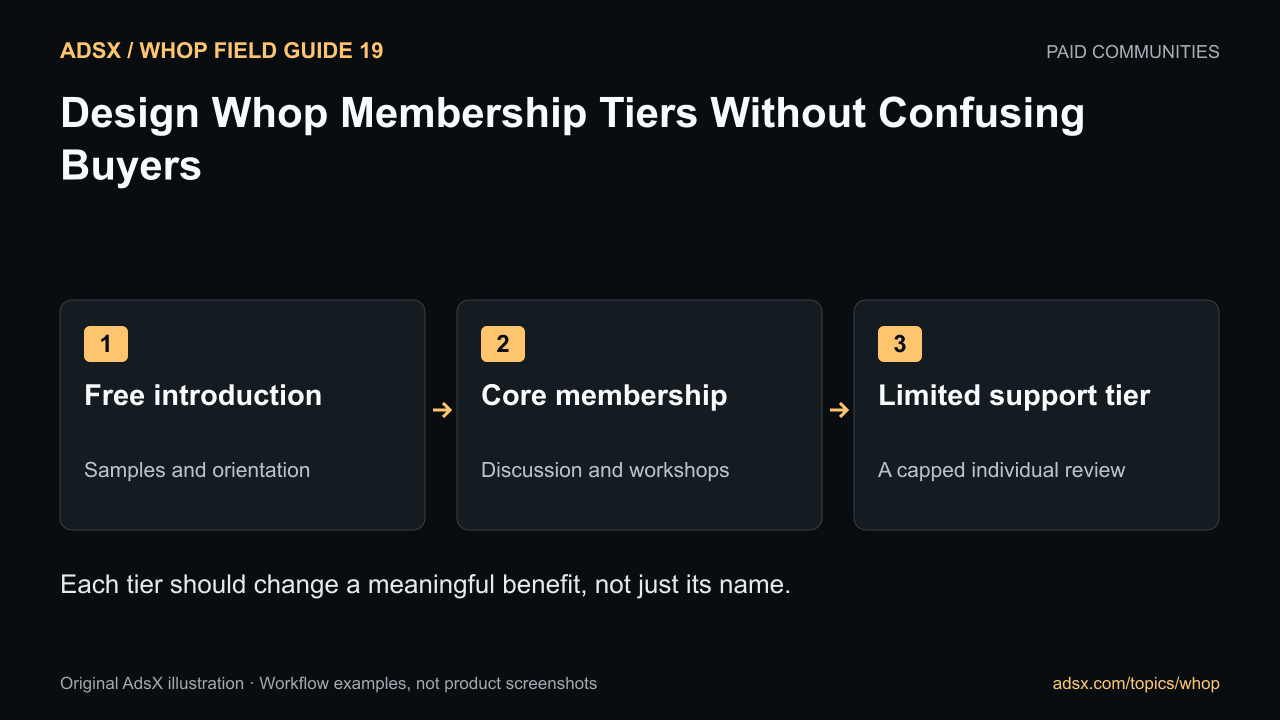
Original AdsX illustration.
Give each tier a clear job
A free introduction can help people understand the community. A core paid tier can provide the main recurring experience. A limited support tier can add work that requires your time.
Whop’s product documentation explains product pricing and app access. Its pricing settings guide covers configuration options that affect purchase and access. Design the offer first, then match those settings to it.
Here is an illustrative structure for an ecommerce operators’ community:
| Benefit | Free introduction | Core membership | Supported membership |
|---|---|---|---|
| Orientation and sample resources | Included | Included | Included |
| Member discussion | Not included | Included | Included |
| Monthly group workshop | Not included | Included | Included |
| Individual page review | Not included | Not included | One per month |
| Personal implementation work | Not included | Not included | Not included |
The last row matters. A review is not the same as doing the implementation for the member.
Separate price options from different benefits
Monthly and annual payment options can represent the same membership with different billing commitments. A higher support tier changes the service itself. Keep that distinction visible so buyers do not assume that paying annually unlocks benefits you intended for another product.
Document the exact access each product grants. If several products unlock the same app, check the behavior when a member holds more than one purchase. Do not make cancellation of one product accidentally remove an entitlement still covered by another.
For a course-plus-community offer, use the more detailed bundle access matrix.
Cap benefits that consume individual time
Suppose each supported member receives a 20-minute review and a 10-minute written follow-up. Ten members create five hours of work each month before scheduling and exceptions. Twenty members create ten hours.
Set the tier’s capacity around that obligation. Whop documents purchase-limit options, but a configured limit is only useful if it matches the service you can actually deliver. Do not describe a membership purchase cap as physical-product inventory; those are different operational concepts.
If demand exceeds your capacity, change the offer deliberately. A group review, waitlist, or separate consulting package may be more sustainable than quietly reducing the promised feedback.
Make upgrades and exits understandable
Explain what changes when someone upgrades, when charges occur, and how access is affected. Verify the available billing behavior in your account rather than promising automatic credits or prorating without evidence.
Use a short buyer-facing comparison table and put important limitations beside the benefits. The customer should not discover a feedback cap only after paying.
Check free, core, and supported views with normal member permissions. Our Discord access guide covers the additional role checks required when the community runs there.
Add tiers only when they solve a real difference
A single clear paid offer is a reasonable starting point. Add another tier when it serves a distinct need and the delivery economics work. Review support questions to see whether buyers understand the difference.
Start your Whop business through AdsX’s referral link, then configure the smallest tier structure that accurately represents your member promise.