Start a paid Whop community with a recurring member promise, a realistic participation schedule, and a clear reason to return. Choose the apps after deciding what members will actually do together.
Disclosure: AdsX owner Dennis Hegstad is employed at Whop. AdsX may earn a commission from qualifying businesses referred through our signup links. This article uses public sources reviewed October 4, 2026; examples are illustrative unless stated otherwise. Editorial policy.
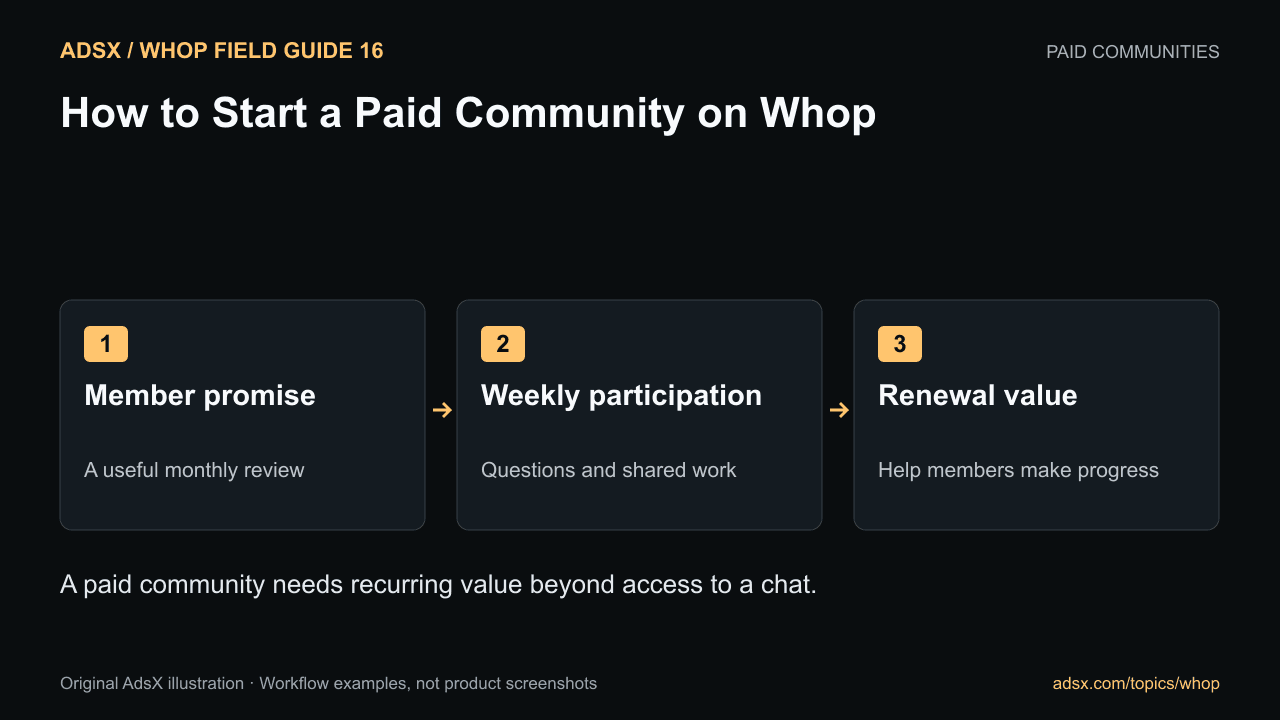
Original AdsX illustration.
Define the recurring value
A useful community serves a specific group with a repeated need. For example, independent ecommerce operators might meet to review merchandising decisions and compare the results of small store experiments. The value comes from relevant discussion and follow-through, not the existence of another chat room.
Whop’s paid-group documentation describes community delivery through apps such as Chat, Forums, Content, and Events. Its product setup guide explains how products connect pricing and access.
Write a promise that you can keep during an ordinary week. “One facilitated review and a maintained resource library each month” is easier to evaluate than “unlimited growth insights.” Avoid promising business outcomes that depend on members’ execution, market conditions, and budgets.
Plan the first month
An illustrative operating schedule could look like this:
| Week | Member activity | Operator work |
|---|---|---|
| One | Introduce a current merchandising problem | Welcome members and organize questions |
| Two | Attend a focused discussion | Prepare examples and moderate the session |
| Three | Share one change made in the store | Prompt useful feedback and answer common questions |
| Four | Review what happened and choose the next topic | Summarize learning and update the resource index |
The schedule is deliberately modest. A small community benefits more from a dependable rhythm than a calendar full of sessions nobody can prepare for.
Choose a primary place for participation
A Whop-native community can keep content and conversation together. An existing audience may prefer Discord or Telegram. Choose based on the activity and the audience rather than assuming more channels create more value.
If you use several spaces, explain their purpose. For example, a forum can hold durable questions while chat handles quick coordination. Do not make members search three channels for the authoritative answer to a billing or access question.
Set membership boundaries
State the price, billing interval, included activities, moderation rules, and support route. Identify whether sessions are recorded and what access remains after cancellation. Use the membership-tier guide if you need more than one paid level.
Set clear rules for promotion, harassment, confidential business information, and the use of shared materials. Assign responsibility for moderation instead of assuming members will resolve every conflict themselves.
Measure participation that reflects value
A member count alone does not tell you whether the community is useful. Track how many new members complete a first relevant action, return for another activity, and receive a useful response when they ask for help.
Review cancellations alongside those observations. A member who finished a short-term goal may leave satisfied; another may leave because the promised discussion never happened. Treat those situations differently.
Start with a cohort small enough to support well. Adjust the schedule using actual participation and workload before adding tiers or more frequent events.
Create your Whop community through AdsX’s referral link. Build the first month’s experience and verify paid access before inviting a wider audience.