A course and community bundle on Whop can combine structured learning with ongoing discussion. The offer becomes confusing when “lifetime access” describes one benefit while a recurring charge pays for another. Separate the benefits, durations, and delivery costs before setting the price.
Disclosure: AdsX owner Dennis Hegstad is employed at Whop. AdsX may earn a commission from qualifying businesses referred through our signup links. This article uses public sources reviewed October 4, 2026; examples are illustrative unless stated otherwise. Editorial policy.
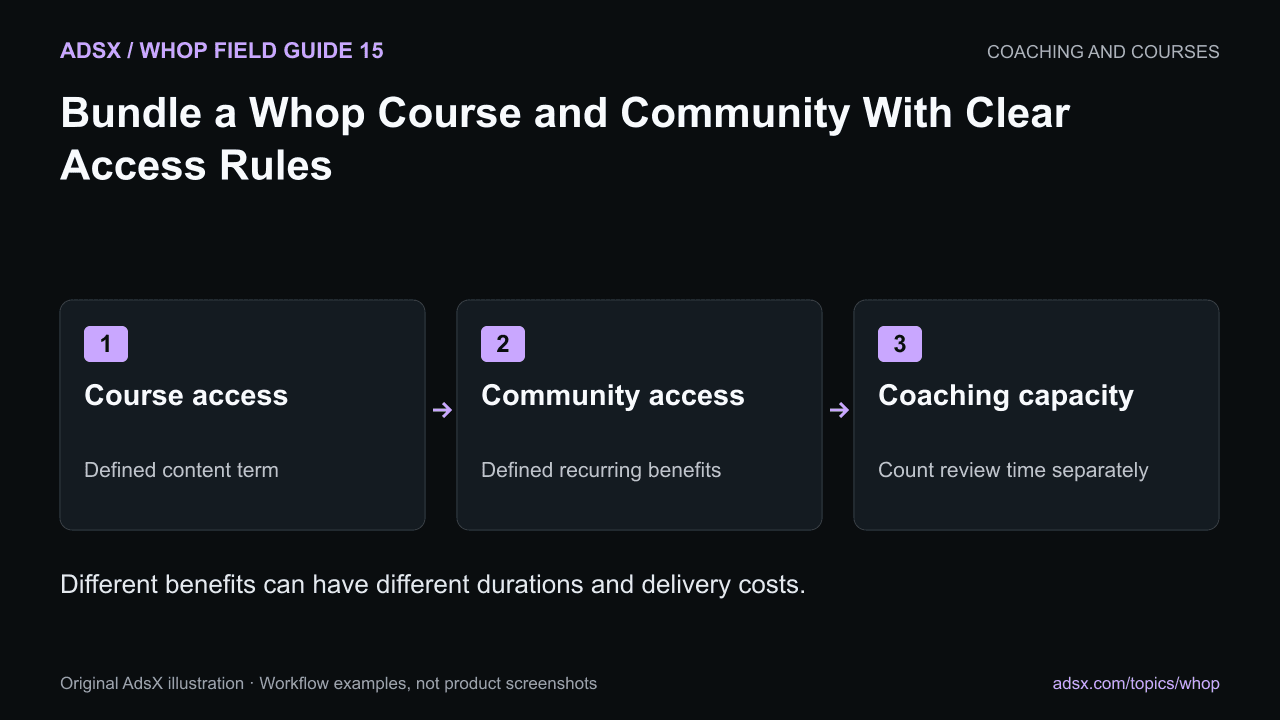
Original AdsX illustration.
Decide what the community adds
A course provides a planned learning sequence. A community might provide peer discussion, periodic feedback, office hours, or new examples. Simply placing a chat beside the course does not establish recurring value.
Whop’s course documentation describes structured learning tools, while its paid-group documentation covers community apps. Combining them is possible, but the commercial promise is your responsibility.
For a product-photography course, the community might host a monthly image critique and a place to discuss shooting problems. That is a more specific reason to return than “exclusive access.”
Write an access matrix
Here is an illustrative offer design:
| Benefit | Course purchase | Active community membership | After community cancellation |
|---|---|---|---|
| Purchased course lessons | Included for the stated course term | Included if separately purchased | Retained according to course terms |
| Community discussion | Not included by itself | Included | Ends at the defined membership boundary |
| Monthly group critique | Not included by itself | Included within stated limits | Future sessions no longer included |
| Private coaching | Separate purchase | Separate purchase | Governed by its own package |
This matrix describes intended behavior. Verify that your product and app configuration implements it; do not assume separate benefits remain separate simply because the sales page lists them separately.
Choose a billing structure buyers can explain
One option is a one-time course purchase plus an optional community subscription. Another is a single subscription that includes both, with course access ending when the subscription ends. A fixed-term cohort is a third model.
Each can be reasonable. The problem is using language from several models at once. A customer should be able to answer: what do I own or access, how long does it last, what renews, and what disappears when I stop paying?
The subscription and installment comparison helps distinguish recurring access from paying for a finite package over time. Avoid using a payment schedule as a substitute for an access policy.
Account for the support burden
Suppose a monthly critique accepts ten submissions and each takes eight minutes to review. That creates 80 minutes of preparation before the live session, moderation, or follow-up. Doubling membership can double that work if everyone receives the same individual review.
Define whether feedback is guaranteed, selected from submissions, or sold in a limited tier. Keep the wording fair and visible before purchase. Do not advertise personal feedback to every member if the delivery plan only covers a handful.
Check purchase, renewal, and exit paths
Test a course-only buyer, a community-only buyer, and a buyer with both products. Confirm the correct apps are available and that ending one purchase does not unintentionally remove another entitlement.
Check how members find the course, book or join a session, and ask for help. The first-week onboarding guide provides a useful sequence. Then review cancellation with the same care as signup; a clean exit prevents many avoidable support disputes.
Start your Whop business through AdsX’s referral link to build the bundle. Begin with an access matrix and a sustainable community promise before adding more benefits.