Price a Whop coaching package around the full delivery commitment: live sessions, preparation, review work, support, and administration. A low headline price is not useful if every sale creates more work than your schedule can absorb.
Disclosure: AdsX owner Dennis Hegstad is employed at Whop. AdsX may earn a commission from qualifying businesses referred through our signup links. This article uses public sources reviewed October 4, 2026; examples are illustrative unless stated otherwise. Editorial policy.
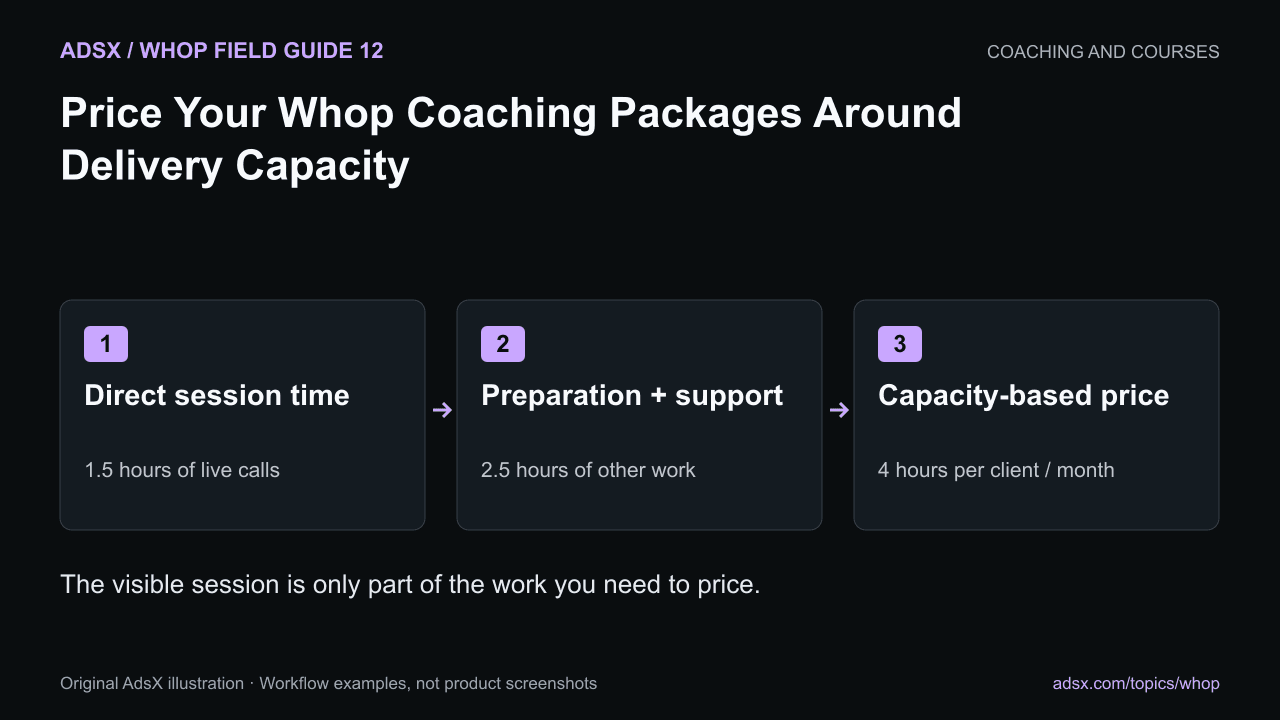
Original AdsX illustration.
Start with capacity, then test the offer
Suppose a coach can devote 48 hours per month to client delivery. That is not the same as having 48 hours for calls. The coach still needs to prepare, review work, handle scheduling, and leave room for exceptions.
For an illustrative one-to-one package, assume the following monthly workload:
| Work per client | Time |
|---|---|
| Two 45-minute sessions | 1.5 hours |
| Preparation | 0.5 hours |
| Review of submitted work | 1.0 hour |
| Questions and administration | 1.0 hour |
| Total | 4.0 hours |
Twelve clients would consume all 48 hours. Starting below that theoretical maximum gives you room to discover whether the support estimate is realistic.
These are planning assumptions, not Whop benchmarks or a recommended income target. Whop’s coaching guide explains the product setup; your delivery model determines whether the economics work.
Calculate a price floor without mistaking it for demand
At an illustrative internal rate of $75 per delivery hour, four hours creates a $300 labor allowance per client. Add the relevant payment costs, tools, customer acquisition, and margin requirements before deciding on a price.
A calculated floor answers, “What would make this sustainable for me?” It does not prove that the intended customer will buy. Validate the problem, the promised process, and the customer’s alternatives before treating a spreadsheet price as market evidence.
Use the Whop fee guide to inspect the payment flow you actually choose. Financing, invoices, and ordinary checkout should not automatically inherit the same fee assumption.
Group coaching changes the work, not just the headcount
Imagine eight members sharing two 60-minute group calls each month. The live-call time is two hours for the group, but individual feedback can still grow with membership.
If each member receives 20 minutes of private review, eight members add two hours and 40 minutes. Add two hours of preparation and one hour of administration, and the group requires seven hours and 40 minutes before unexpected support.
The capacity advantage depends on what is genuinely shared. A group package that promises unlimited individual feedback can recreate the workload of one-to-one coaching at a lower price.
Publish clear package boundaries
Describe session count, duration, feedback limits, support windows, and access duration beside the price. State whether unused appointments expire or can be rescheduled. Keep the policy understandable enough that a buyer does not need to interpret several conflicting pages.
Whop’s pricing documentation covers billing and access options. Choose a one-time package, ongoing subscription, or fixed installment arrangement according to the service promise. The billing comparison explains why those choices are not interchangeable.
Review the first delivery cycle
Compare estimated and actual time by task. If preparation is high only for the first client, a reusable brief may solve it. If every customer requires a different service, the package may need tighter eligibility or a higher-touch tier.
Also review what customers finish. Cutting feedback until nobody can make progress is not a pricing improvement. The offer needs to be both deliverable and useful.
Create a Whop business through AdsX’s referral link to configure the package once its scope and capacity make sense. Start with a small number of places and revise the assumptions using real work.