A Whop subscription pays for an ongoing offer. A fixed installment plan spreads a finite purchase across scheduled charges. Third-party financing introduces a separate provider and eligibility rules. Monthly payments can appear in all three, but the customer’s commitment and the merchant’s cash flow differ.
Disclosure: AdsX owner Dennis Hegstad is employed at Whop. AdsX may earn a commission from qualifying businesses referred through our signup links. This article uses public sources reviewed October 4, 2026; examples are illustrative unless stated otherwise. Editorial policy.
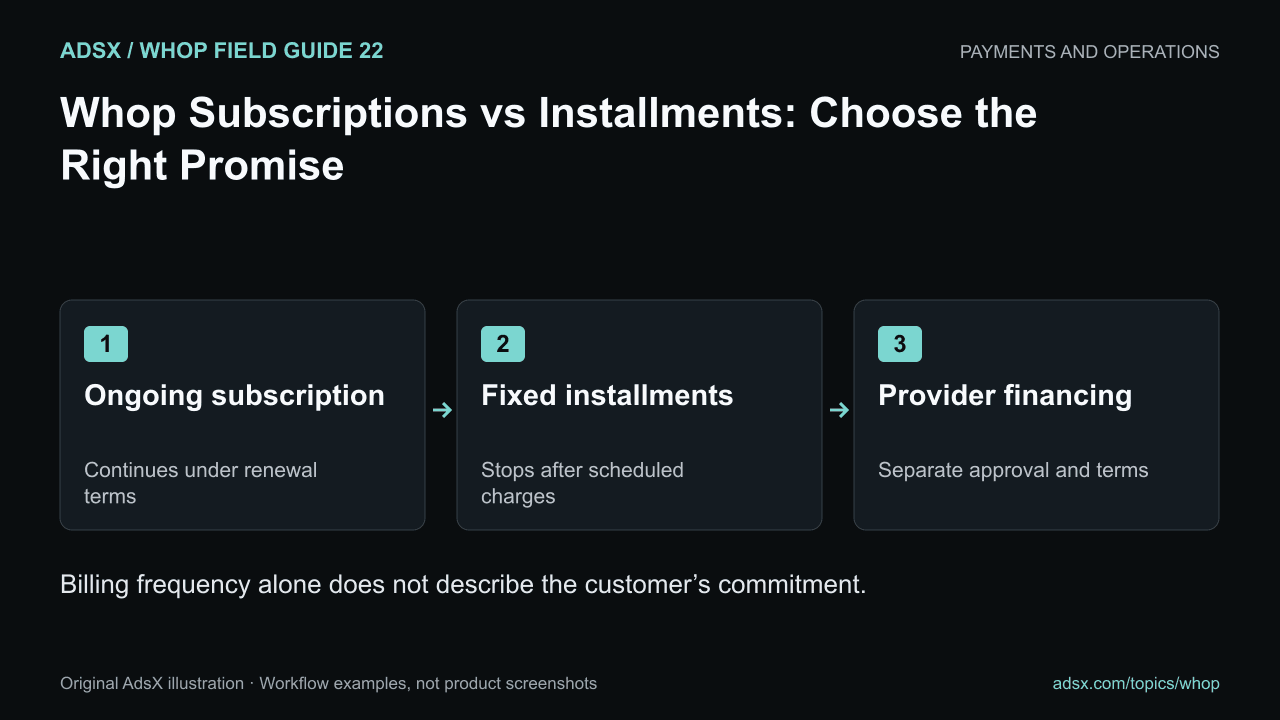
Original AdsX illustration.
Match billing to the promise
Whop’s checkout-link documentation describes one-time payments, recurring offers, and split payments. Its financing documentation covers provider-based options separately.
| Structure | Example offer | What the buyer needs to understand |
|---|---|---|
| Subscription | Continuing community access | Amount, interval, renewal, and cancellation terms |
| Fixed installments | A defined course package paid in three parts | Total purchase price, number of charges, and access terms |
| Provider financing | An eligible one-time purchase financed through a provider | Approval, provider terms, repayment schedule, and applicable costs |
These examples describe different arrangements. They are not interchangeable settings for making the same offer look cheaper.
Compare the payment timelines
Consider a hypothetical $300 course package. A one-time purchase collects the agreed $300 at checkout. A merchant-managed three-payment plan of $100 collects the amount over its configured schedule if the payments succeed. The first $100 does not mean the merchant has already collected the full $300.
By contrast, a $100 monthly community subscription continues according to its renewal terms. It does not necessarily stop after three payments. Calling it “three easy payments” would misdescribe the product unless the configured schedule actually ends there.
Write the total price and the number of payments clearly for a fixed package. For subscriptions, state the recurring commitment rather than inventing a fixed total for an indefinite service.
Treat financing as a separate approval path
Whop’s financing application guide describes business eligibility and checkout restrictions. Availability can depend on the business, product category, buyer location, currency, amount, and provider decision. Do not advertise every financing method to every buyer as guaranteed.
Settlement also varies by provider and account terms. The official documentation identifies exceptions and reserves, so “financed” should not be read as “the entire sale is immediately withdrawable.” Review the applicable fees and payout conditions before including financing in a cash-flow plan.
A merchant-managed installment schedule does not automatically transfer collection risk to a financing provider. Determine who handles a failed later payment and what happens to access or undelivered work.
Separate billing from access
A learner might receive all course lessons immediately while still owing future installments. A community subscription might grant access only while active. A coaching package might include appointments over a fixed period.
Document those rules independently. The course and community bundle guide shows how to map benefits to access periods. Verify that the product configuration implements the policy you publish.
Check exceptions before launch
Review cancellation requests, failed payments, refunds, and incomplete delivery. A billing cancellation, a refund, and a membership termination are different actions; our merchant workflow explains how to keep them aligned.
Use the customer-facing checkout preview to confirm the amount, interval, total commitment where applicable, and access description. Do not rely on an internal product name to communicate those terms.
Create your Whop business through AdsX’s referral link, then choose the billing structure that accurately represents the product you can deliver.