Whop for Platforms is intended for businesses that facilitate payments for other sellers, such as marketplaces and multi-tenant applications. Plan the buyer, seller, payment, refund, and payout relationships before treating the integration as a checkout button.
Disclosure: AdsX owner Dennis Hegstad is employed at Whop. AdsX may earn a commission from qualifying businesses referred through our signup links. This article uses public sources reviewed October 4, 2026; examples are illustrative unless stated otherwise. Editorial policy.
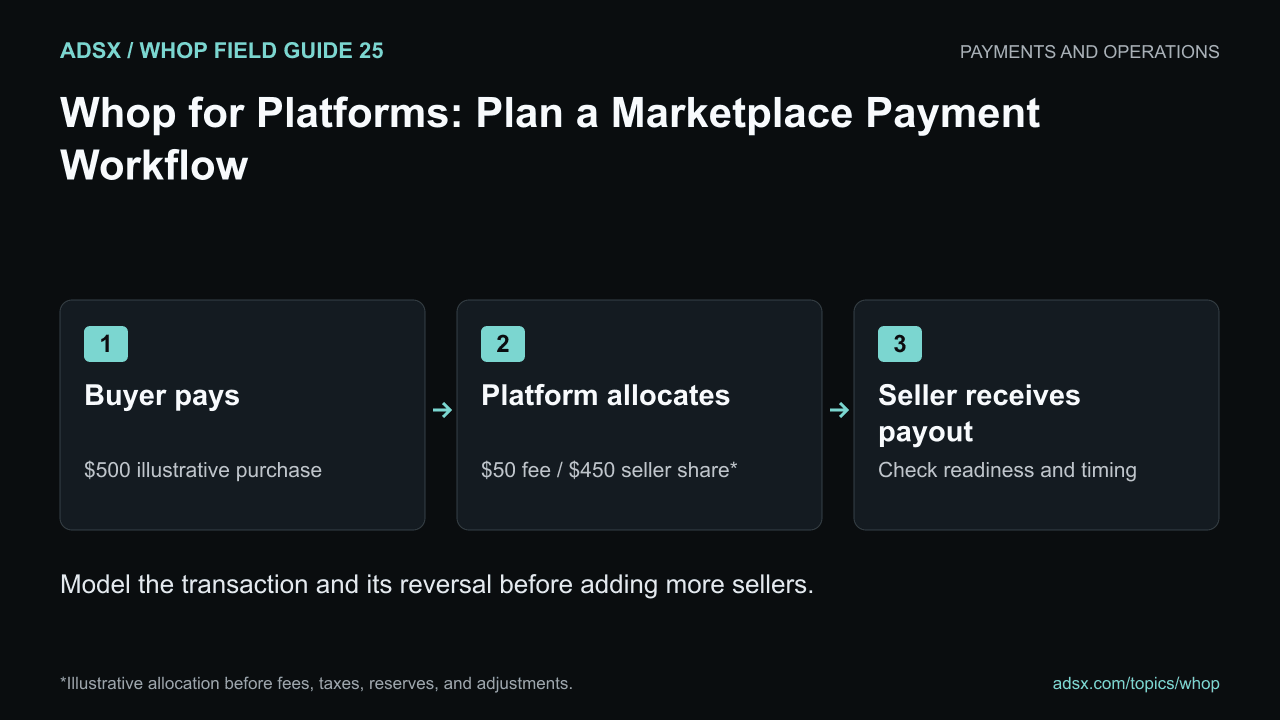
Original AdsX illustration.
Decide whether you are a platform or one merchant
A business selling its own course or service can often use an ordinary product and checkout workflow. A marketplace that lets independent providers sell to customers has additional questions: who the seller is, who receives the proceeds, and who handles exceptions.
Whop’s connected-account documentation describes onboarding businesses or individuals and facilitating payments for them. Its Payments Network overview provides broader context for platform payment infrastructure.
This guide is a planning framework. It does not establish that every marketplace category or country is eligible, or that a particular account already has platform access.
Map the parties and their responsibilities
For an illustrative marketplace of product-photography services, the parties might be:
| Party | Responsibility to define |
|---|---|
| Buyer | Supplies the brief and pays for the agreed service |
| Photographer | Delivers the service and resolves work-quality issues |
| Marketplace operator | Manages discovery, platform rules, and the support path |
| Payment infrastructure | Processes the configured transaction and account flows |
Document who communicates with the buyer, who approves refunds, and who owns the delivery record. Payment infrastructure does not decide whether a photograph satisfies a creative brief.
Model the money and its reversal
Suppose a buyer pays $500 and the platform’s agreed fee is 10%. The commercial allocation would be $50 to the platform and $450 to the seller before processing costs, taxes, reserves, and other applicable adjustments. This is an arithmetic example, not a claim about Whop’s pricing or default allocation.
Now model a $100 partial refund. Decide how the platform fee changes, how the seller’s proceeds change, and what happens if funds have already moved. Do not assume the reversal will match your preferred policy without checking the integration and account terms.
Keep identifiers that connect the order, payment, seller account, allocation, and any refund. Those relationships matter when a customer asks about a charge weeks later.
Treat onboarding and payout readiness separately
A seller creating an account does not necessarily mean they can receive a payout immediately. The connected-account documentation notes that identity verification may be required. Design a visible readiness state and a support path for incomplete information.
Avoid collecting sensitive identity information in an improvised form when the provider offers the appropriate onboarding flow. Review the official developer documentation linked from the connected-account guide for the integration supported by your setup.
Also distinguish a successful customer payment, an available account balance, and a completed payout. Those events can occur at different times.
Plan failure cases before scaling
Write acceptance cases for duplicate notifications, failed payments, refunds after allocation, unavailable sellers, and interrupted onboarding. A repeated event should not create a duplicate order or transfer. A failed operation should leave enough information for a safe retry and reconciliation.
Use an appropriate test environment before handling real funds. This article does not claim that AdsX implemented or tested a marketplace payment integration. For the merchant-facing operational side, see the refund workflow and service-business guide.
Start your Whop business through AdsX’s referral link to explore the platform path, then confirm product eligibility and the supported integration with Whop before committing to a production architecture.