Whop’s published standard domestic-card processing rate is 2.7% plus $0.30 per successful transaction, reviewed on October 4, 2026. That is a starting input for a budget, not a promise that every sale costs only that amount. Payment method, international cards, currency conversion, optional services, payouts, and your account’s terms can change the bill.
This guide uses Whop’s public pricing and fee documentation. The documentation says its listed pricing applies to new merchants signing up now; existing or negotiated account terms may differ. AdsX may earn a commission from qualifying Whop referrals.
Disclosure: AdsX owner Dennis Hegstad is employed at Whop. This article is published by AdsX. See our editorial policy for our relationships and research standards.
Separate base processing from conditional fees
The standard pricing page advertises no setup fee or monthly cost for its pay-as-you-go offer. That does not make payment processing, fulfillment, or running the business free.
| Published item | Listed amount | Condition to check |
|---|---|---|
| Domestic cards | 2.7% + $0.30 | Successful transaction |
| International cards | Additional 1.5% | International-card treatment |
| Currency conversion | Additional 1% | Conversion required |
| Orchestration | 0.8% | Enabled |
| Billing | 0.5% | Enabled |
| Tax and remittance | 2% | Enabled and tax collected |
| Next-day ACH payout | $2.50 | Per successful payout |
These are selected published items, not an exhaustive fee schedule. Other payment methods, financing, dispute events, and payout methods have separate terms. Check your dashboard and applicable agreement before enabling a service or setting a margin target.
Whop’s documentation explicitly says revenue-optimization charges stack on top of base processing. Do not subtract an optional fee from the base rate or assume that an advertised service is included simply because it appears on the same product page.
A $50 order, worked through
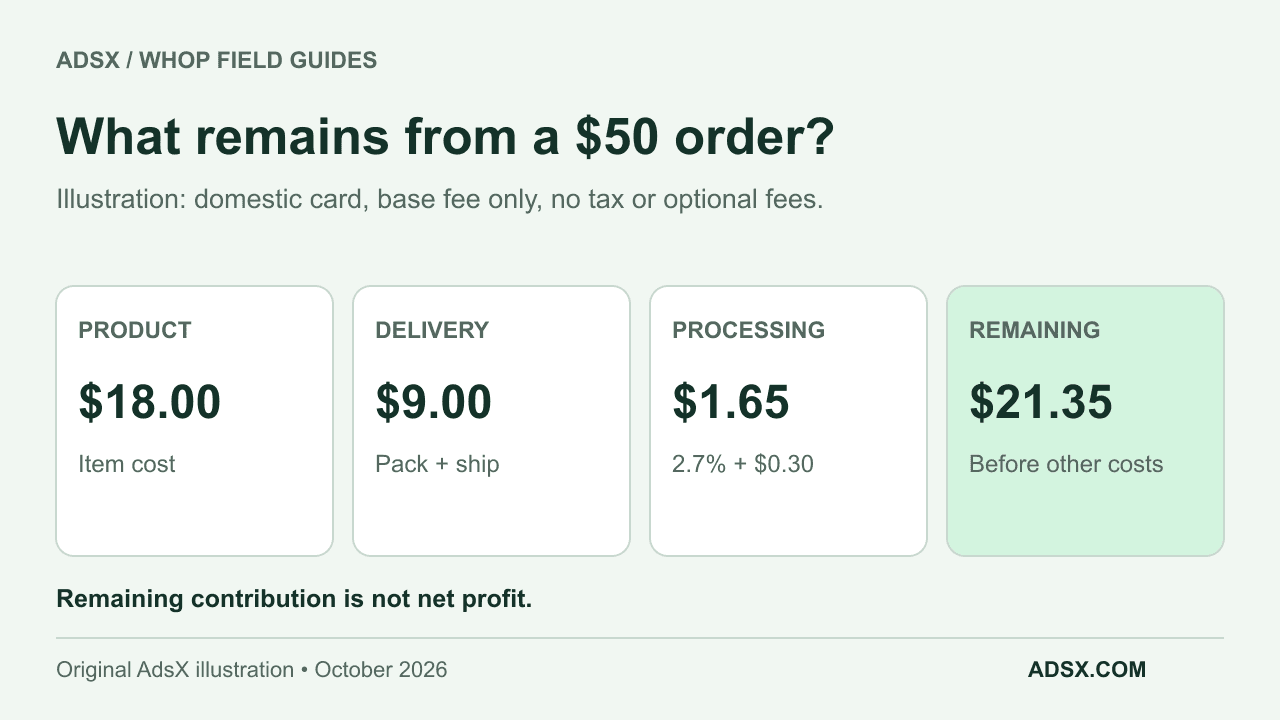
Consider a hypothetical domestic-card order for $50 with no currency conversion, optional charges, refunds, tax, or affiliate commission in the example. The base processing calculation is:
$50 × 0.027 + $0.30 = $1.65
That leaves $48.35 after this processing fee. If the item costs $18 and packaging plus delivery costs $9, the remaining contribution is $21.35. It is not net profit: you still need to account for acquisition, returns, labor, software, overhead, and any other applicable fees.
The fixed $0.30 also changes the effective percentage at smaller order values. With the same simplified domestic-card assumptions, a $10 order incurs $0.57 in base processing, or 5.7%. A $100 order incurs $3, or 3%. The posted percentage alone does not capture this difference.
Use the actual amount on which a fee is assessed in your account, especially when shipping or tax is collected. This example deliberately avoids those complications so the arithmetic is visible.
Model optional services as separate scenarios
Suppose the same $50 example has orchestration, billing, and tax-and-remittance charges enabled, and tax is collected as required for that last fee to apply. Whop’s published stack totals 6% plus $0.30, which would be $3.30 on a $50 fee base. Compared with the base-only scenario, that is another $1.65.
This is a fee illustration, not a recommendation to enable or disable those services, and not a calculation of tax owed. The actual fee base and applicability need confirmation. Evaluate what each service does for your operation before comparing its cost with a percentage-point saving.
For 100 otherwise identical $50 orders, the base-only arithmetic is $165. At the illustrated 6% plus $0.30 stack it is $330. Neither figure includes payout fees or the other business costs above.
Payment costs and payout costs happen at different times
A charge to a buyer and a transfer to your bank are separate events. If your selected payout method has a fixed charge, payout frequency can matter. At the published $2.50 next-day ACH figure, four successful payouts would cost $10 and twenty would cost $50.
That calculation is not a recommendation to delay money you need for operations. Confirm eligibility, timing, minimums, reserves, and account terms for the method you actually use. Treat available cash separately from booked sales.
Whop’s payout setup documentation is the next place to check the required account setup. A successful sale does not, by itself, establish that your payout setup is complete.
Build a budget you can reconcile
Use one row per cost category: product, packaging, shipping, processing, conditional services, partner commissions if offered, refunds and disputes, payout charges, and fixed overhead. Keep the transaction count beside revenue; two stores with the same revenue can have different fixed per-order fees.
Start with a quiet month and a busy month. Then add an exception scenario, such as returns on several orders or more international customers than expected. Those estimates should be labeled assumptions until your own transaction records replace them.
The Whop launch checklist includes a cost review before publishing an offer. If you are deciding between platforms, use Whop vs Shopify to compare the whole operating setup. If the economics fit, explore Whop through our referral link, and confirm the fees shown for your business before taking payments.