Before inviting a custom affiliate on Whop, write down the offer they may promote and which payments should earn a reward. A percentage without a duration or product scope is an incomplete deal. Start with the economics, then map the agreed terms to the dashboard.
Disclosure: Dennis Hegstad works at Whop and owns AdsX. AdsX may earn a commission from qualifying businesses referred through our signup links. Public sources were reviewed October 17, 2026. Examples are illustrative, not merchant account tests. Editorial policy.
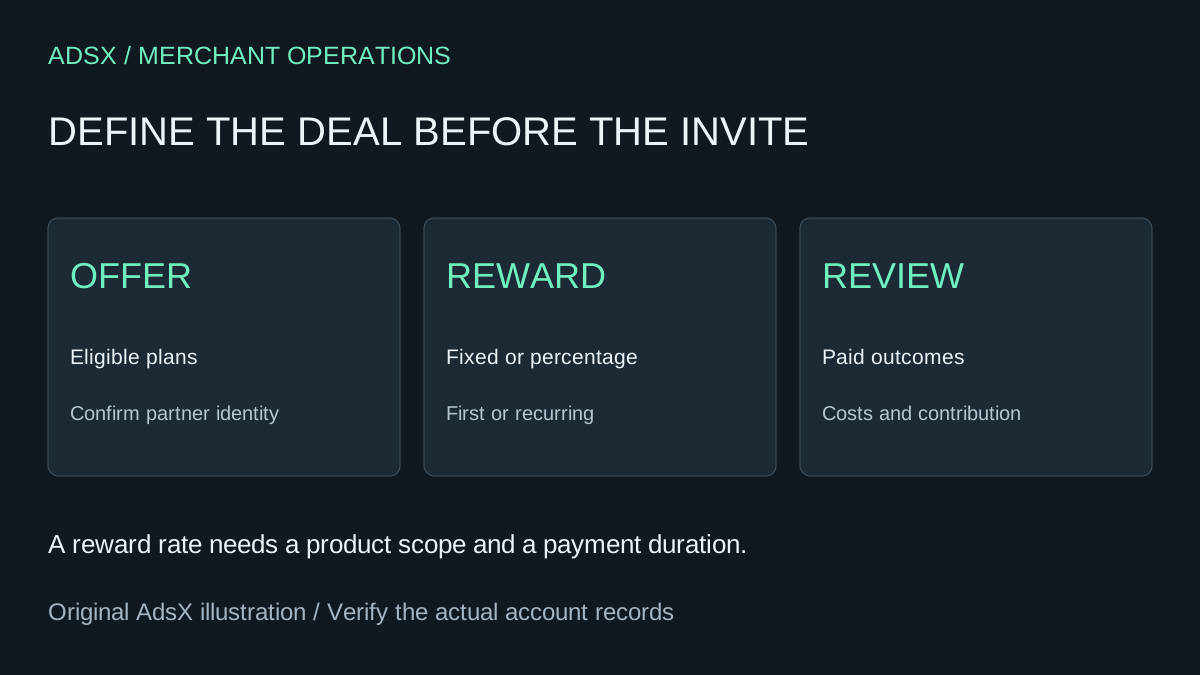
Original AdsX explanatory illustration.
Separate a custom deal from the general program
Whop's custom affiliate documentation describes individually managed arrangements with fixed or percentage rewards. You can choose first-payment or recurring rewards and restrict the eligible plans. The invited affiliate receives a referral link.
The global affiliate guide describes a separate marketplace program, including Global and Member Affiliate Rates. Review those settings alongside a custom deal rather than assuming one negotiated rate describes every affiliate promoting your business.
This article concerns a merchant rewarding referrals to its own products. It does not describe AdsX's Whop Partner enrollment or establish that either program has identical commission or payout terms.
Draft a one-page deal specification
Imagine a fictional design educator selling a $100 monthly workshop membership. A creator wants to recommend it in their tutorials. Before touching the dashboard, agree on these details:
| Field | Example decision |
|---|---|
| Eligible offer | Workshop membership only |
| Reward basis | Percentage of an eligible payment |
| Duration | First payment only for the initial pilot |
| Partner identity | Confirm the correct Whop user |
| Excluded scope | Separate consulting package is not part of this deal |
| Review point | After the first complete month of referred purchases |
The table is a proposed commercial brief, not a description of every contract or reporting field available in Whop. Put any additional agreed obligations in the appropriate written arrangement. Do not assume a dashboard setting captures creative approvals, disclosure requirements, or promises about customer support.
Compare first-payment and recurring economics
Consider a 20% reward on a $100 eligible payment. The illustrative reward is $20. Suppose the merchant also budgets $10 for payment costs, refunds, and other adjustments, and $25 for delivery costs. That leaves $45 before overhead on that payment.
These are hypothetical planning inputs, not Whop fee quotes or a promise about the platform's commission calculation base. Replace them with the applicable terms and actual costs. Our Whop fees guide separates the fee categories you should investigate.
Now compare two possible arrangements over three unchanged $100 payments:
| Planning model | Total illustrative reward | Contribution after $35 other costs per payment |
|---|---|---|
| 20% on first payment only | $20 | $175 |
| 20% on all three payments | $60 | $135 |
The recurring arrangement costs $40 more in this example. That does not make it wrong: the partner may provide ongoing education or attract customers who stay longer. But the additional expense should be a deliberate decision. Do not justify it by counting months of revenue the customer has not yet paid.
A fixed reward needs the same care. If the selling price can change, compare the reward against the lowest eligible price you plan to offer, including promotions. A fixed amount that works on the full price may be unsuitable after a large discount.
Map the brief to the documented setup
Whop documents the path through Marketing and Affiliates, then the option to set a commission for a specific user. The invitation identifies the person by email, username, or user ID. Review the reward type, payment duration, and eligible plans against your brief before submitting it.
Have a second person check the configuration when possible. Read the selection aloud in plain language: “This person earns this reward on these payments for these offers.” If you cannot finish that sentence confidently, resolve the ambiguity before the invitation.
No invitation is needed to complete the planning exercise. You can evaluate whether the arrangement works financially before creating an external commitment or asking a partner to promote it.
Review purchases, not just link activity
Give the pilot a defined review window and inspect referred purchases, reversals or adjustments, and the contribution left after delivery. Keep click activity separate. A busy referral link is useful evidence of interest, but it is not a commission statement.
Our Whop tracking guide explains the distinction between visits and downstream outcomes. Ask how the applicable program handles attribution conflicts, refunds, and changed subscriptions before promising a partner a particular payout result. Do not fill undocumented gaps with assumptions.
If you are evaluating Whop for this workflow, start with AdsX's Whop referral link and confirm the settings and terms available to your business. A sensible first deal is one you can explain, configure, and reconcile after real customer payments arrive.