Your Whop Ads budget should start with what a new customer leaves after variable costs. That contribution sets an upper boundary for acquisition spending. A platform’s minimum budget, available account balance, or reported ROAS cannot tell you what your business can afford.
Disclosure: AdsX owner Dennis Hegstad is employed at Whop. AdsX may earn a commission from qualifying businesses referred through our signup links. This guide is based on public documentation reviewed October 4, 2026, not an AdsX advertising test. Worked examples are illustrative. Editorial policy.
Original AdsX illustration.
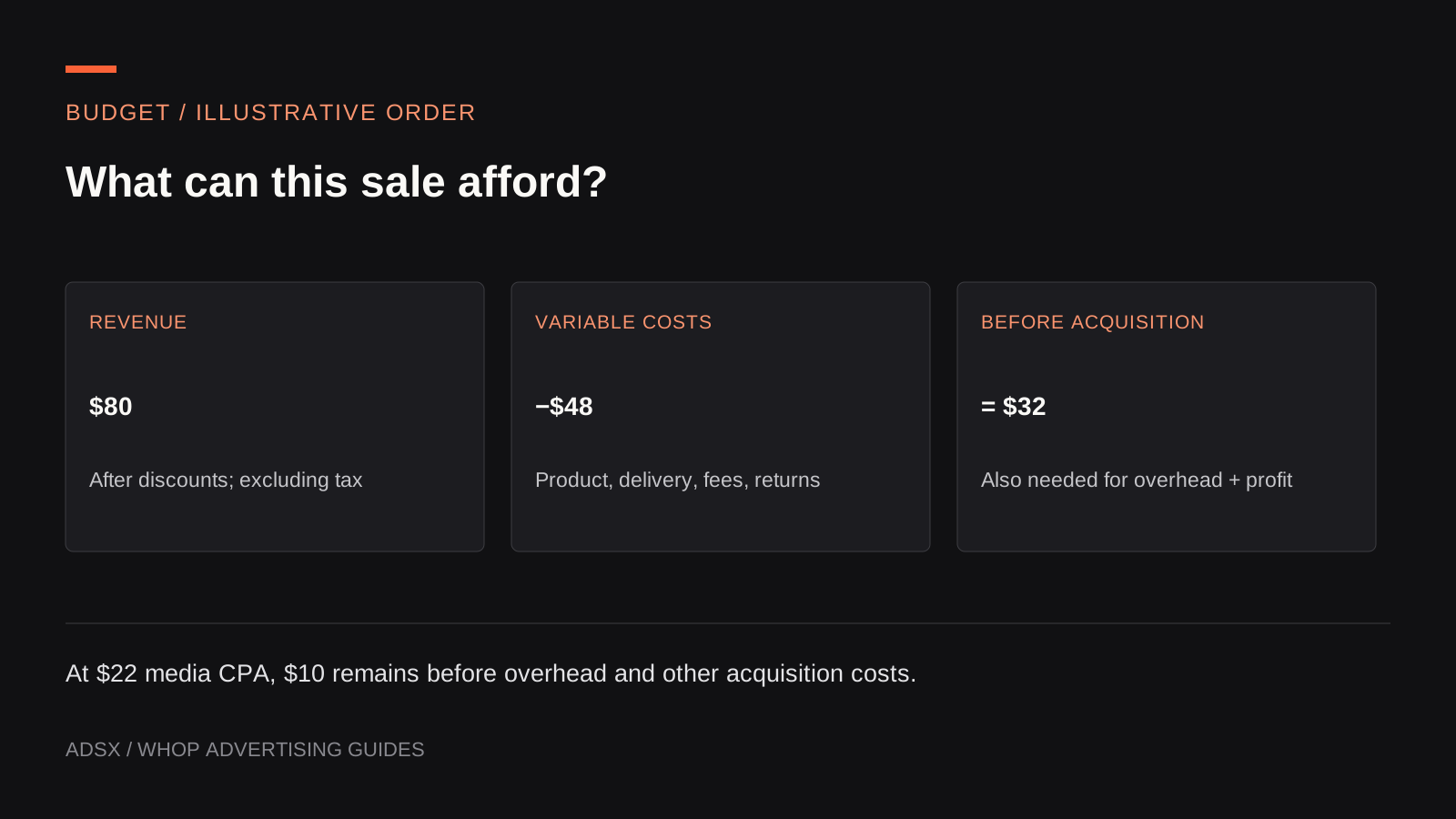
Calculate first-order contribution
Start with money retained from an order, excluding taxes collected for remittance. Subtract the costs that rise when you make that sale: product, packaging, fulfillment, payment charges, shipping subsidy, expected returns, and variable support.
For this worksheet, break-even media CPA means the maximum media cost per acquired customer before fixed overhead and any separate acquisition costs. It is a planning boundary, not a recommended target.
| Illustrative $80 order | Amount |
|---|---|
| Revenue excluding tax, after discounts | $80 |
| Product cost | −$24 |
| Packaging and fulfillment | −$5 |
| Shipping subsidy | −$8 |
| Payment and transaction costs | −$3 |
| Expected return and support allowance | −$8 |
| Contribution before acquisition | $32 |
At a $32 media CPA, this example leaves nothing for overhead, creative production, or profit. A target of $22 would leave $10 per acquired customer before those remaining costs. Whether that is sufficient depends on the business.
Use your own fee schedule and return history. The $3 payment line above is an invented planning input, not a quoted Whop or Shopify rate.
Translate contribution into a ROAS threshold
For a single product with consistent revenue and cost, first-order break-even media ROAS equals revenue divided by contribution before media:
$80 ÷ $32 = 2.5× ROAS.
The $22 CPA target corresponds to approximately 3.64× ROAS, because $80 ÷ $22 is about 3.64. This assumes one order per acquired customer and comparable revenue definitions. Discounts, repeat orders, tax-inclusive reporting, and returns can change the comparison.
Our Whop Ads reporting guide explains why a dashboard ratio may use a different revenue population from your worksheet. Match the definitions before treating the ratio as a spending signal.
Include creative and operator costs
Whop’s merchant Ads guide currently lists no platform subscription or minimum ad spend. That does not remove the other costs of acquisition.
Suppose a campaign spends $300 on media and $120 on a product shoot. If it acquires 12 customers, media CPA is $25, while the combined acquisition cost is $35. In the $32-contribution example, the campaign is $36 short before fixed overhead: 12 × $32 − $420 = −$36.
Keep reusable creative costs visible. You may allocate them over several campaigns for management reporting, but the cash was still spent. Changing the allocation should not be presented as an improvement in advertising performance.
Whop’s advertising billing documentation describes account-level collection across campaigns and separate charging for AI creative generation. Keep those charges distinct in your campaign ledger so a production expense does not disappear inside a media total.
Adapt the model to courses and memberships
A digital product can have a low reproduction cost and still require support, refunds, live instruction, and payment processing. Include the work promised to each buyer.
For an illustrative $120 course with $24 in variable costs, first-sale contribution is $96. That figure is not permission to spend $96 acquiring every student. The remaining contribution must fund course maintenance and overhead, and the assumptions need evidence from actual delivery.
For a membership, separate first-month cash from estimated future contribution. A $30 monthly subscription with $8 monthly variable cost leaves $22 in month one. Assuming four paid months would imply $88 before acquisition, but four months must be supported by retention data. It is not cash available on signup day.
Review cohort retention and payback alongside the subscription billing guide. A business can have attractive estimated lifetime value and still run out of cash while waiting for renewals.
Turn the model into a bounded test
Write an amount you can afford to lose, a target CPA, a review date, and technical stop conditions. For example, a $300 media allocation at a $25 planning CPA represents 12 acquisitions arithmetically. It does not predict that 12 people will buy or establish a statistically decisive sample.
Choose a test you can operate without financial strain. Stop early for a broken checkout or invalid tracking; do not interpret those failures as evidence that the audience dislikes the offer. If the results are inconclusive, record that outcome instead of forcing a winner.
Create a Whop business through AdsX’s referral link when you are ready to evaluate its Ads workflow. Bring a margin worksheet and a spending boundary, then follow the Meta campaign preparation guide.