A generated screen can resemble a Shopify app while leaving its hardest work unbuilt. Recurring billing, accumulated balances, moderation and exception handling often matter more than the visible interface. Keep a specialist app when the replacement cannot yet preserve the records and operations your business relies on.
This is a decision guide for functions with ongoing obligations. For simple display features, start with the app replacement framework. The examples here are hypothetical review exercises, not a report of completed migrations or a recommendation to retain every subscription.
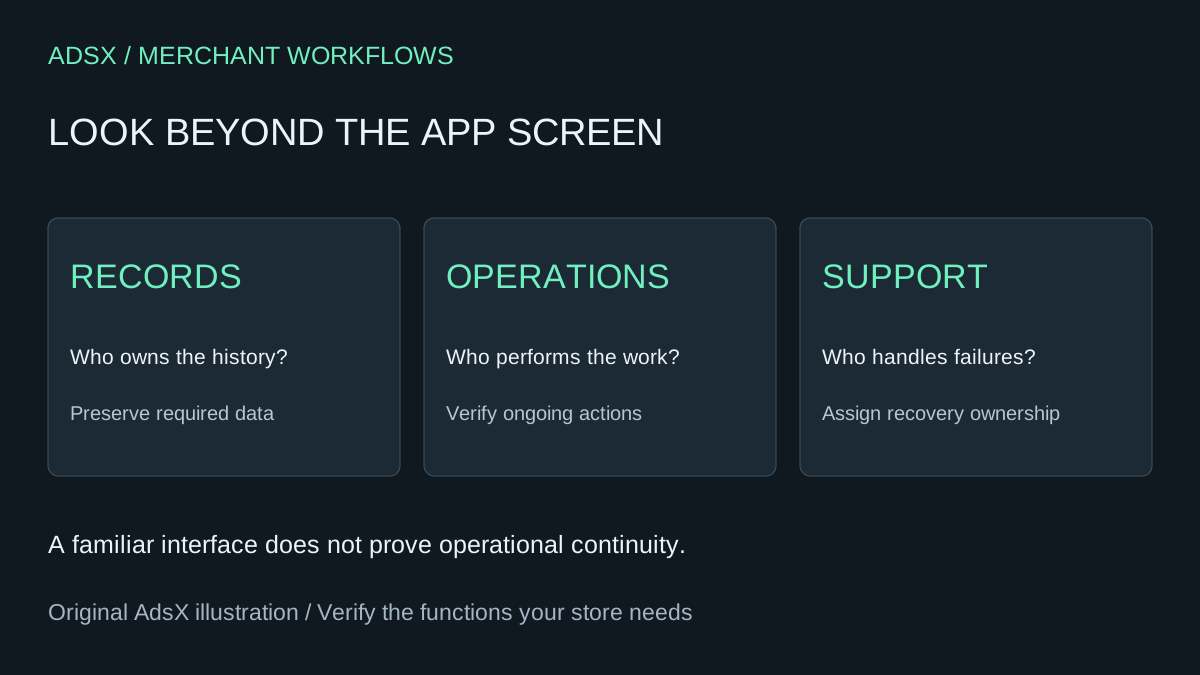
Original AdsX illustration.
Identify what must survive the interface
Ask what would happen if the app's interface disappeared tomorrow. Would a customer still be billed, retain a balance, receive a return label or see an authentic review? Identify where those records live and which system is responsible for updating them.
A useful dependency table has four columns: record, current owner, downstream action and recovery method. A CSV export can preserve information without preserving the process that acts on it. A customer list, for example, is not a running subscription billing system.
| Function | Question the replacement must answer |
|---|---|
| Recurring purchases | Who manages contracts, failed payments and customer changes? |
| Loyalty | How are balances, expiry and reversals reconciled? |
| Returns | Who handles eligibility, labels and refund exceptions? |
| Reviews | How are provenance, moderation and display preserved? |
These are evaluation questions, not claims that every app in each category offers the same capabilities. Check the documentation and account configuration for the specific tool you use.
Treat subscriptions as an operating system
Shopify supports its free first-party subscription app as well as third-party options. Its subscription documentation explains that customer payment information is securely stored by Shopify. It also states that uninstalling a third-party subscription app deletes app-created subscription data after 48 hours, with exceptions for subscription contracts and payment information.
Those exceptions do not establish that a new tool will take over every existing contract or retain every app-specific setting. Obtain a documented migration path before removing the existing tool. Inspect renewal behavior, customer self-service and what happens to failed or skipped payments. Our subscription portal checklist helps define the customer-facing requirements.
AI can help compare documented requirements or draft test cases. It should not invent payment credentials, assume a contract transfer is supported, or treat a new dashboard as proof that billing continuity exists.
Build a read-only aid before replacing the system
Sometimes the useful AI project is a report beside the specialist app. For example, staff might need a list of unresolved cases grouped by age. A read-only view can help them prioritize work while the original tool remains responsible for transactions and customer records.
Specify exactly which data may be read, how fresh it must be and how staff return to the authoritative record. If an API or export is unavailable, the project needs another approved input. Do not imply that a prompt bypasses permissions or creates an integration.
This approach can improve a workflow without reducing the subscription bill. Report that honestly. Operational usefulness and app-cost savings are different outcomes.
Use an ownership-review prompt
This original prompt has not been execution-tested:
Review replacing [specific app function] using the supplied documentation and configuration summary. List the records, scheduled actions, customer controls, integrations and support responsibilities involved. For each, identify the current owner and evidence required before a replacement can assume responsibility. Separate a read-only helper from a full replacement. Mark missing migration support as unknown. Do not recommend uninstalling the app or claim feature parity from screenshots.
Give the assistant redacted configuration details and public documentation, not credentials or unnecessary customer data. Ask the staff who handle exceptions to review the output; they often know requirements absent from the normal happy path.
Compare support and recovery costs
Consider an invented scenario: a $49 recurring fee looks avoidable, but the replacement would require two hours of monthly support valued at $40 per hour. That is $80 of recurring labor before hosting or initial development. The subscription can be the cheaper option even if code generation costs nothing extra.
Use your actual invoice, billing interval and support estimates in the replacement cost worksheet. If the app's free or lower tier meets the required function, evaluate that too. Do not count an entire fee as saved when another essential feature keeps the subscription active.
Set a concrete condition for revisiting the choice
“Keep for now” should have a reason: no verified export, no maintained billing integration, unresolved recovery behavior, or insufficient support capacity. Record the evidence needed to change the decision and an owner for reviewing it.
Shopify's uninstall guidance is the starting point for removal, not a substitute for app-specific migration instructions. Only retire the existing tool after required records, operations and customer paths are verified. Until then, use AI where it has a clear, bounded role.