A $20 app is not automatically an expensive app. If replacing its useful function takes six hours and someone must maintain the result, the replacement can cost more than the subscription. AI can reduce implementation effort, but a generated first draft is only one part of the bill.
Use this worksheet after defining the exact function you want to replace. It is a cost decision, not an app-stack inventory; our app cost audit covers finding the charges in the first place. All numbers below are hypothetical, not measured merchant savings or vendor quotes.
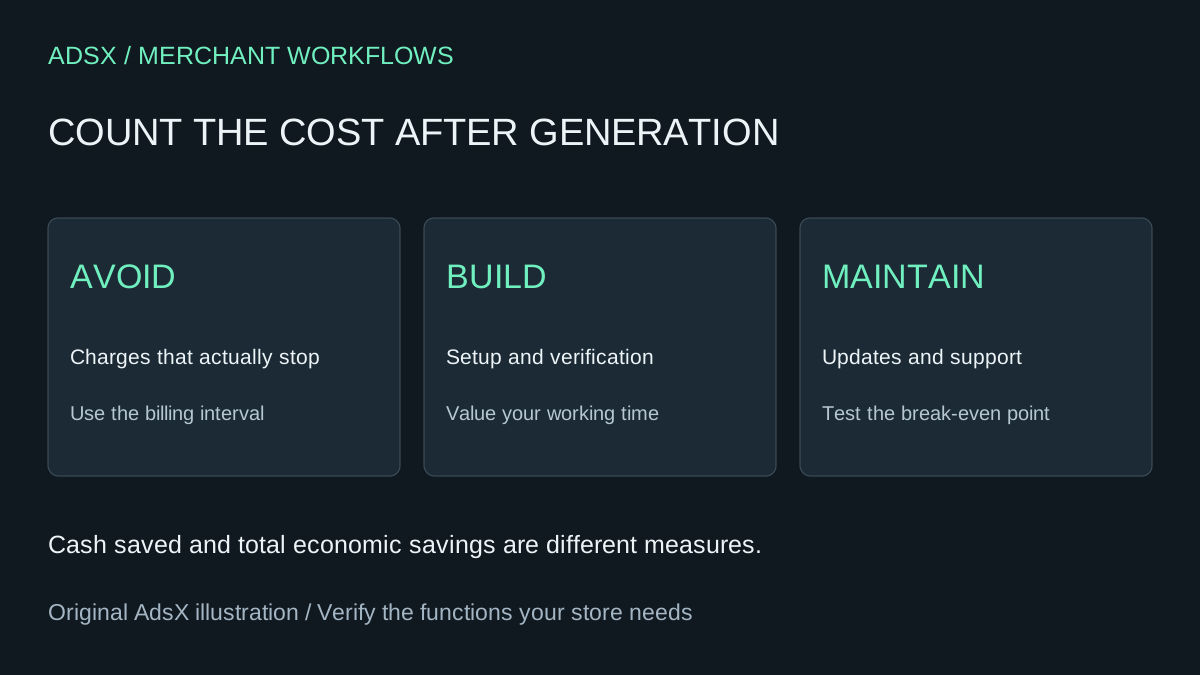
Original AdsX illustration.
Compare the same job over the same period
Write a one-sentence scope, such as “display an approved measurement table on twelve product pages.” Do not compare that display with the entire subscription for an app that also provides recommendations, analytics and localization you still use. If the subscription remains necessary, its fee is not avoided.
Record the billing interval from your actual account. Shopify's app billing documentation distinguishes recurring, usage and one-time charges. It also notes that external subscriptions can require separate cancellation. Twelve 30-day app billing cycles are 360 days, not an exact calendar year. An annual contract needs its own renewal and cancellation assumptions.
Exclude the Shopify plan cost when both options require the same plan. Include an incremental plan upgrade if the replacement depends on it. A free app does not make that upgrade free. For example, Shopify Flow has plan-specific action availability, so check the required action before choosing the cheaper-looking route.
A worked replacement worksheet
Imagine a merchant considering a basic theme widget instead of a subscription. Use a 12-period comparison with an assumed $20 charge per period. The merchant values their own work at $40 an hour. These inputs are illustrative and should be replaced with actual estimates.
| Item | Keep the app | Build the limited replacement |
|---|---|---|
| Subscription over 12 periods | $240 | $0 |
| Incremental tools or hosting | $0 | $24 |
| Setup and verification: 4 hours | $0 | $160 |
| Maintenance: 15 minutes per period | $0 | $120 |
| Total modeled cost | $240 | $304 |
The replacement reduces cash charges by $216 if all labor is the owner's unpaid time, but costs $64 more after valuing that time. Neither number is a promise. Paid contractor labor changes the cash column too. Existing paid AI access can have zero incremental subscription cost for this project, while a new subscription purchased solely for the build belongs in the calculation.
The app may also require maintenance or configuration. Add that effort to its column when material. Avoid treating one option as maintenance-free simply to make the other look expensive.
Find the break-even point
For a stable recurring workload, divide one-time replacement cost by the net recurring saving. In this example, recurring cost is $2 for tools plus $10 of labor per period. The $20 fee avoided leaves $8 per period. Recovering $160 of setup takes 20 periods, longer than the comparison window.
If recurring replacement cost equals or exceeds the avoided fee, there is no positive break-even point under those assumptions. Do not present a negative or infinite result as “instant savings.” Recalculate when a theme update, API change or new requirement changes the work.
A useful sensitivity check is to double the maintenance estimate. In this example, 30 minutes of labor plus $2 of tools costs $22 per period. The replacement now costs more to operate even before setup. This is why a narrow scope and a named maintainer matter.
Ask AI to expose assumptions
This original planning prompt has not been execution-tested:
Compare keeping this Shopify app with replacing only [function]. Use these actual charges and billing intervals: [inputs]. Use these setup, testing, maintenance and tool estimates: [inputs]. Separate cash spending from owner labor valued at [rate]. Exclude costs shared by both choices. Show the comparison over [period], calculate break-even only when recurring savings are positive, and repeat with twice the maintenance time. Mark unknowns rather than assuming zero. Identify retained app features that would prevent cancellation. Do not claim measured savings.
Check every multiplication yourself. An assistant can organize a model without knowing your cancellation terms, theme complexity or future support needs. Keep the estimate with the implementation brief so scope changes trigger a new calculation.
Include the work after generation
Budget for reviewing code or configuration, checking accessibility and mobile behavior, documenting the change and teaching the next person how to maintain it. Externally hosted apps can add hosting, monitoring and integration upkeep. A theme section has a different maintenance burden; choose the Shopify surface before estimating.
Do not assign an invented dollar value to a possible outage. Instead list the failure, its operational effect and who would repair it. A replacement that saves $8 a period but has no owner during a busy launch may be a poor decision even when the arithmetic is positive.
Before canceling, use the AI app acceptance checklist and confirm the actual billing end date. The decision is complete when the required function works, the old dependency is resolved and future charges actually stop. Keep the app when the full comparison favors it.