Whop Economic Intelligence is an AI system that recommends a next business action and can execute an accepted recommendation through Whop’s tools. The useful question for a merchant is whether a proposed action fits the business, has a clear boundary, and produces a measurable result.
Disclosure: AdsX owner Dennis Hegstad is employed at Whop. AdsX may earn a commission from qualifying businesses referred through our signup links. This article uses public sources reviewed October 4, 2026; examples are illustrative unless stated otherwise. Editorial policy.
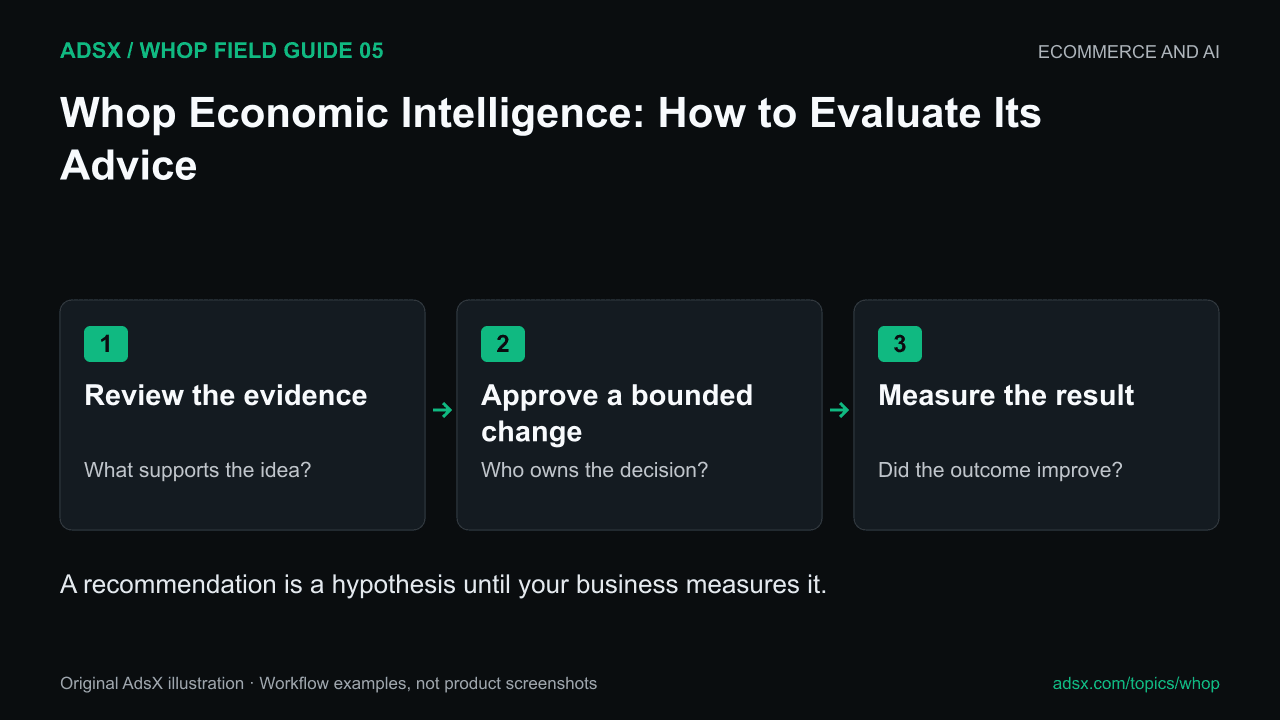
Original AdsX illustration.
Whop introduced the system in its September 30 announcement. The article describes dashboard recommendations involving areas such as websites, advertising, and customer engagement. This is an assessment of the public announcement, not a hands-on review or a promise of improved revenue.
Separate the recommendation from the decision
A recommendation might identify a useful opportunity while leaving an important business constraint unstated. Perhaps an offer needs clearer copy, but the product is temporarily unavailable. Perhaps more traffic would help, but the service team has no capacity for additional customers.
Before running an action, write down the problem you think it solves. If you cannot describe the current problem independently, ask for more context rather than treating the recommendation as a command.
| Review question | Useful evidence |
|---|---|
| What is the problem? | A specific drop-off, customer question, or operational delay |
| Why this action? | Data or a reason that connects the action to the problem |
| What will change? | Named pages, offers, campaigns, or settings |
| What can it cost? | Spending, staff time, discounts, and other commitments |
| What counts as success? | A defined outcome and observation period |
| How can we reverse it? | Previous content or settings and a responsible owner |
A worked example: a weak service page
Imagine a photographer receives inquiries from people expecting a full-day shoot, although the advertised package includes a two-hour session. An AI recommendation to improve the page could be useful, but the goal is better qualification rather than more clicks at any cost.
The proposed change might clarify session duration, image delivery, and add-on availability. Keep the price and package scope fixed for the first review. Compare relevant inquiries before and after, and ask whether customers now understand the offer.
If several things change together—copy, pricing, audience, and advertising spend—you may observe a result without knowing which change caused it. Smaller, documented changes are easier to learn from.
Treat published growth figures as context
Whop’s announcement presents a before-and-after comparison for businesses using the system. That design does not, by itself, establish how much growth the AI caused. Seasonality, changes in the sample, merchant effort, and other simultaneous changes can affect the result.
For your business, compare the same definitions over a suitable period. Whop’s analytics documentation distinguishes user and payment measures. A higher visit count, more successful payments, and more profit are different outcomes.
Avoid judging a change before customers have had enough time to act. Equally, do not leave a harmful change running simply because the evaluation period has not ended. Define stop conditions for incorrect promises, broken checkout, or unexpected spending.
Keep the human review specific
A useful approval says what the system may do. For example: revise the description of one existing product using verified facts, then present the result for review. An instruction to “grow the business” leaves scope, spending, and acceptable tradeoffs unclear.
Keep private customer information out of prompts unless the service and your business policies permit that use. Have the person responsible for the business approve spending, public commitments, and changes that affect customers.
Our tracking guide explains how to separate traffic from commercial outcomes. The service-business guide helps define the offer an AI recommendation would be changing.
Evaluate one useful recommendation
Create your Whop business through our partner link, review the capabilities available in your dashboard, and choose a bounded action with an observable outcome. Keep a record of what changed and what you learned before expanding automation.
For campaign preparation, use the AI advertising workflow to separate product facts, creative drafts, and spending approval.