A consulting retainer on Whop should describe the work reserved for a client each billing period. “Ongoing support” is too vague to price, deliver, or evaluate. Define the monthly promise before you turn on recurring payments.
Disclosure: AdsX owner Dennis Hegstad is employed at Whop. AdsX may earn a commission from qualifying businesses referred through our signup links. This article uses public sources reviewed October 4, 2026; examples are illustrative unless stated otherwise. Editorial policy.
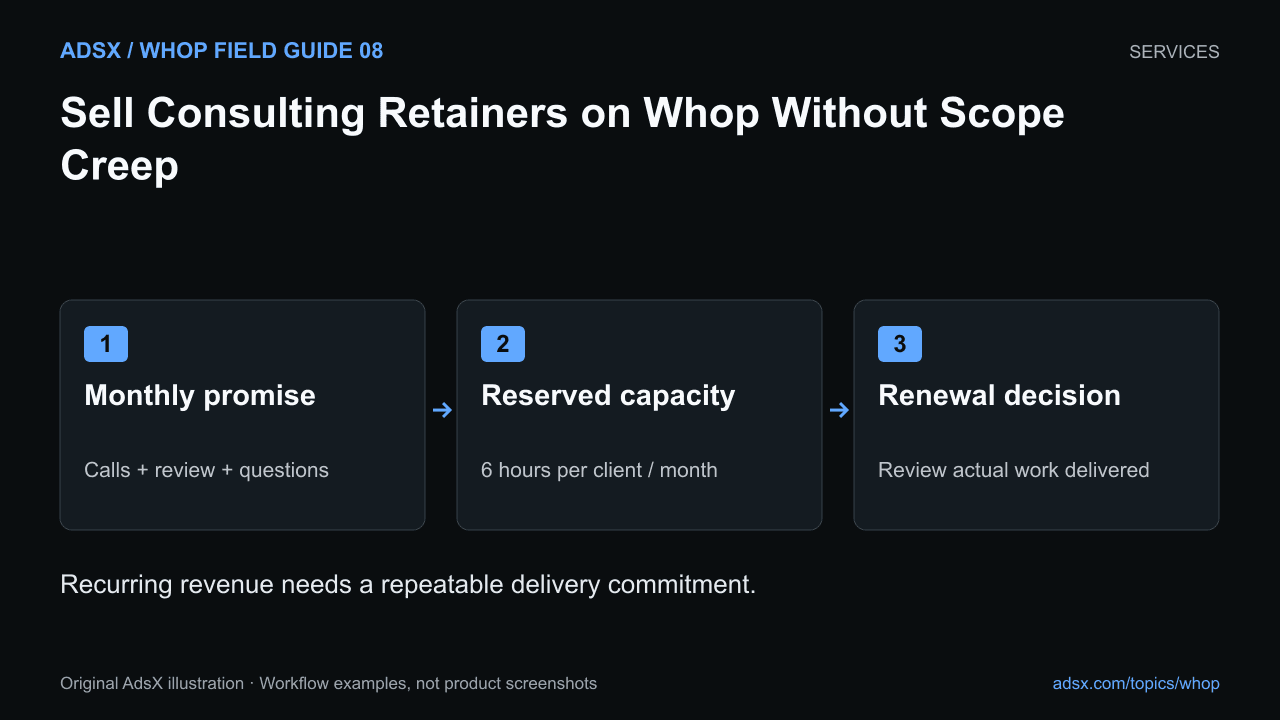
Original AdsX illustration.
Choose what the retainer reserves
A retainer might reserve access to your advice, a fixed set of deliverables, or a limited amount of working time. Those are different products. Avoid combining all three under an unlimited promise.
For example, a merchandising consultant could offer two 45-minute calls, one assortment review, and written questions in a designated channel. The agreement would also define response days, the number of products covered, and whether unused calls carry forward.
Whop supports recurring service offers through its agency workflow and pricing configuration. The platform collects the payment; your offer still needs to make the service commitment understandable.
Price the work you actually perform
Here is a hypothetical monthly capacity estimate for one client:
| Work | Hours |
|---|---|
| Two 45-minute calls | 1.5 |
| Call preparation and notes | 1.0 |
| Assortment review | 2.0 |
| Questions and administration | 1.5 |
| Total delivery time | 6.0 |
At an illustrative internal rate of $100 per hour, the delivery-time floor is $600 before payment costs, software, acquisition, unused capacity, and profit. That is a planning calculation, not a market-rate recommendation.
If you have 36 hours available for client delivery each month, six such retainers consume all of it on paper. Selling every hour leaves no room for delays or unusually demanding reviews. A lower initial cap gives you time to measure the real workload.
Make the checkout promise match the agreement
State the recurring amount, billing interval, included work, and how the customer cancels. Explain when the first service period begins and how you schedule the initial call. Keep special negotiated terms in a written scope the client can retain.
A recurring retainer differs from paying for a fixed project in installments. If you owe a finite deliverable, use the subscription versus installment guide to choose the appropriate structure.
Whop University’s official checkout tutorial provides an overview of creating a payment link. Interface details can change; use the current documentation for the options in your account.
Watch the checkout-link tutorial on YouTube.
Keep a monthly service record
Record the calls delivered, reviews completed, questions answered, and next recommendation. The record should show useful work without turning every client interaction into a dispute over minutes.
Review actual time after the first billing period. If a six-hour package consistently takes nine hours, change its scope, price, or process before accepting more clients. More subscriptions can make an underpriced service harder to repair.
Handle renewal and cancellation deliberately
Whop’s member-management documentation distinguishes canceling a membership from terminating it immediately. Align the operational action with the client’s paid service period and your stated terms. Also cancel future appointments or reserved work when appropriate; a billing change is not a complete scheduling workflow.
Use a client portal if it makes the monthly record easier to share. Create your Whop business through AdsX’s referral link to configure a focused retainer, then check the purchase, access, and renewal experience before opening more capacity.