Disclosure: AdsX may earn a commission from qualifying Shopify referrals through signup links. Examples and worksheets are original editorial planning aids, not observed merchant results. Sources checked November 28, 2026.
Original AdsX explanatory illustration.
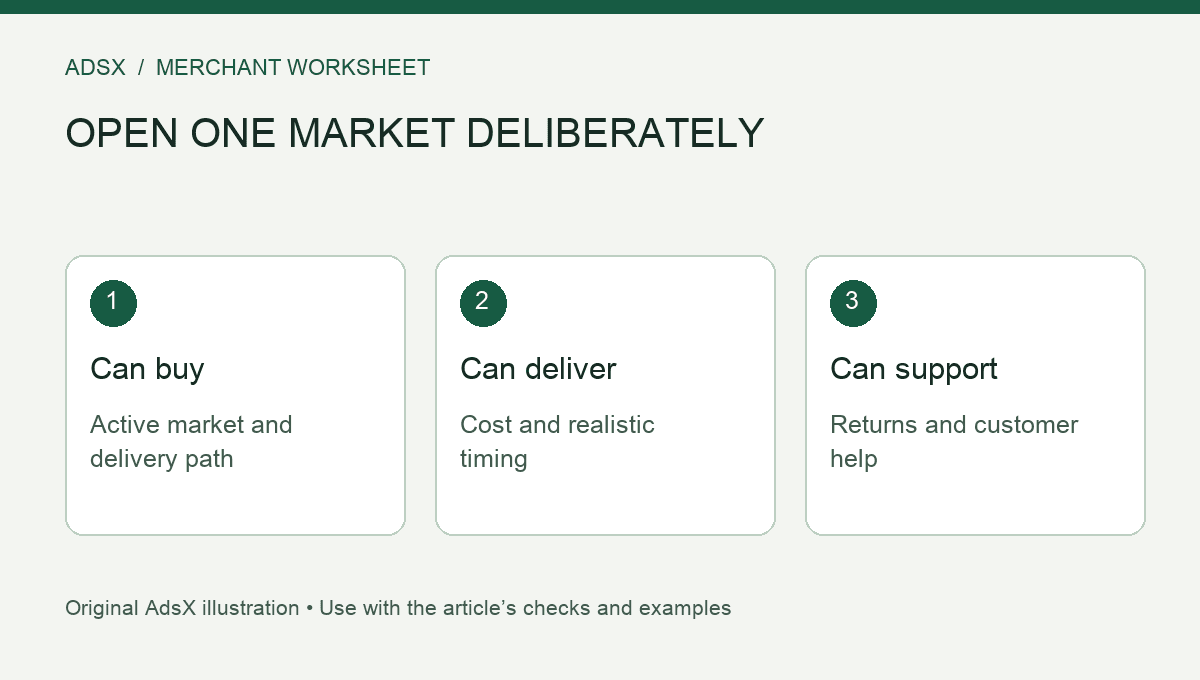
Start with the smallest territory where you can reliably take payment, deliver the order, explain the total cost, and handle a problem. For many first stores that is the domestic market. An existing cross-border audience or a specialist fulfillment arrangement may justify launching internationally sooner.
The decision is about operating readiness, not whether Shopify can display a country selector. More eligible destinations can create more exceptions before they create meaningful demand.
Make a territory decision sheet
Choose one domestic and one possible international destination. Compare a real packed product, not a generic shipping estimate. Record the origin, destination, package size, weight, delivery service, tracking, expected handling time, and return destination.
| Question | Evidence needed before opening the market |
|---|---|
| Can this customer check out? | A verified market and delivery configuration |
| What will delivery cost us? | A current carrier or fulfillment quote for the packed item |
| What will the buyer pay? | Checkout total and clearly explained additional obligations |
| Can we resolve a return? | A feasible address, process, and cost owner |
| Can we answer questions? | Support language, hours, and escalation owner |
A missing answer is a reason to narrow the launch, not an invitation for AI to fill in a plausible number.
Separate market activation from shipping availability
Shopify documents that a checkout destination needs both an active market and an available shipping configuration. Adding a country to one setting alone is not a complete buying path.
The shipping interface is also changing: Shopify's shipping rate instructions describe a gradual move from profiles and rates to shipping options by market. Use the controls available in your store. Do not assume a screenshot from another merchant is the interface you should see.
Check a representative address in each launch territory and a deliberately unsupported address. The supported address should show the intended service and charge; the unsupported one should not accidentally receive an attractive but unfulfillable rate. Check different basket weights and products if they use different delivery rules.
Use contribution math to expose the tradeoff
Here is an original hypothetical comparison for a $45 product with $16 product cost and $2 packaging. Assume $1.80 payment cost solely for the example; it is not a quoted Shopify rate.
Domestic delivery costs $7 and the buyer pays $5 delivery. Contribution before labor, returns, tax obligations, acquisition, and fixed expenses is $50 minus $26.80, or $23.20.
International delivery costs $22 and the buyer pays $12 delivery. On the same simplifying assumptions, contribution is $57 minus $41.80, or $15.20. Currency conversion, international payment costs, and import-related costs are not modeled; obtain applicable quotes before relying on the comparison.
An international sale is not automatically bad. The example shows why identical product pricing does not imply identical economics. Use the startup cost calculator for the wider budget and keep destination-specific expenses visible.
Do not promise a universal landed price
The applicable product rules, customs treatment, taxes, duties, and responsible parties vary. Confirm the requirements with the relevant official authorities and your carrier or adviser for the actual route. A shipping estimate alone does not establish compliance or the amount a buyer may owe on arrival.
Keep the customer explanation consistent across the product page, shipping information, checkout, and support responses. If you cannot explain who handles a charge or a failed delivery, resolve that before promoting the destination. Avoid copying a competitor's international policy as if it described your carrier contract.
Set an expansion gate
For a domestic-first launch, decide what evidence would justify adding the next market. A useful gate might require successful fulfillment of a manageable pilot, accurate packing costs, documented return handling, and enough destination-specific inquiries to investigate demand. These are proposed operating criteria, not statistically proven thresholds.
For an international-first launch, reverse the exercise: identify which countries you will deliberately leave closed. A clear supported list is easier to maintain than a worldwide promise with exceptions scattered through the site.
Use Start a Shopify Store for account and launch setup, then review the first paid-order pilot. Expand when the next territory has a complete operating plan, not merely because the platform lets you activate it.