Examples and worksheets are original editorial planning aids, not observed merchant results. Sources checked November 28, 2026.
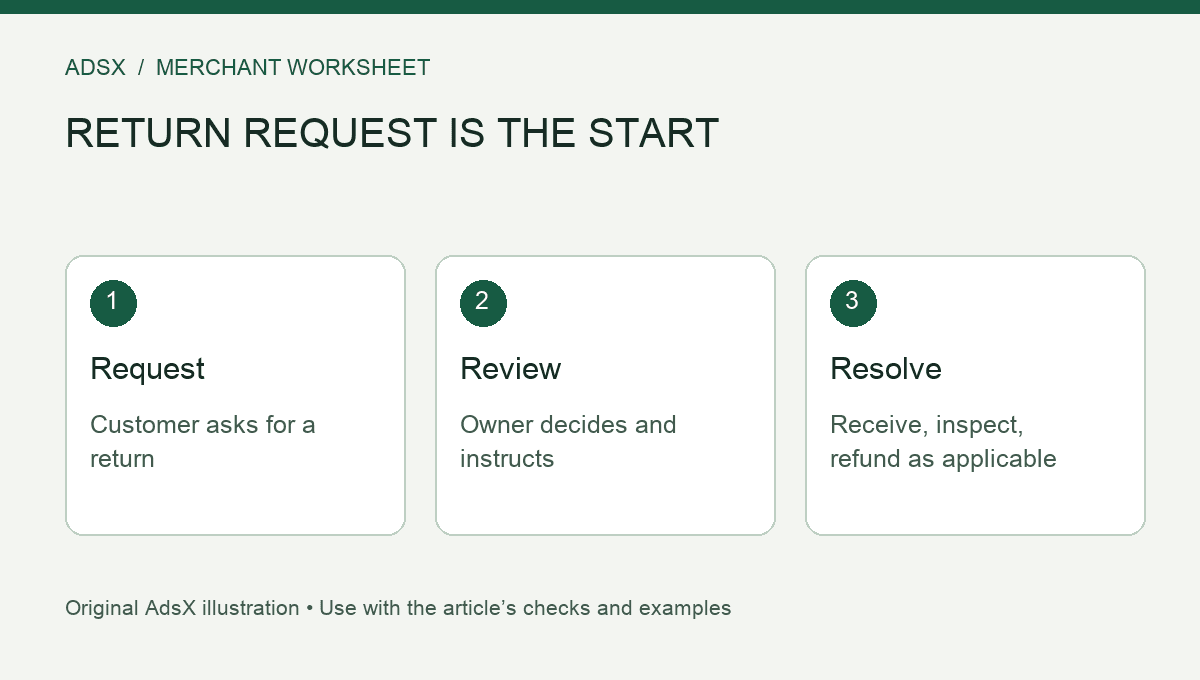
Original AdsX explanatory illustration.
Before your first sale, decide who will handle the first return request. The important distinction is between a customer asking to return something, your decision on that request, the item's physical arrival, and the financial resolution. Those events do not necessarily happen together.
This is an operating worksheet, not a template for deciding customers' legal rights. Apply your published policy and the requirements that govern the actual transaction.
Choose an intake route customers can reach
A small store can begin with a clearly explained contact route, provided someone monitors it. Shopify also documents self-serve returns and cancellations, where customers submit requests for merchant review. A request is not the same as an automatic refund.
If you use the native self-serve route, follow the current setup requirements, including access to the new customer accounts experience. Check the features in your actual store. Do not advertise an exchange request option merely because the merchant can later add exchange items during processing.
Give each stage an owner
Use an internal reference and keep customer details in the store's approved tools.
| Stage | Decision or evidence | Owner to assign |
|---|---|---|
| Request received | What item and problem are involved? | Support |
| Review completed | What response follows the policy and applicable requirements? | Authorized decision-maker |
| Instructions sent | Where and how should the customer send the item? | Support or operations |
| Parcel received | What actually arrived and in what condition? | Receiving |
| Resolution | Refund, exchange, or other appropriate action recorded | Authorized operator |
One person may own all five roles in a new store. Writing them separately still prevents a message in the inbox from being mistaken for a completed refund.
Walk through a hypothetical case
A customer orders two mugs and asks to return one. Support records the specific line and quantity, reviews the request, and sends the appropriate instructions. When the parcel arrives, the receiver checks that it contains the expected item. The financial resolution follows the verified facts and applicable policy.
If the box contains something different, record the discrepancy and investigate. Do not tell an AI assistant to infer the customer's intent. The partial-return review covers that later exception in more depth.
Rehearse without creating customer confusion
Use a controlled test scenario to verify that the intake route, notifications, and internal handoff are understood. Do not send test return messages to real customers or create refunds simply to see what happens. Distinguish a planning rehearsal from an observed production transaction.
Include the route in your contact-page test and check the instructions on mobile. If a return app is proposed, identify the exact missing capability and ongoing cost before buying it. A documented low-volume process may be sufficient; a high-volume or complex process may need stronger tooling.
Complete this worksheet during Start a Shopify Store, rather than waiting until a disappointed customer forces the decision. You cannot remove every exception, but you can make sure the next action has an owner.