A successful test order tells you that a configured path works. A small soft launch tests whether you can deliver the promise to a real customer: the right product, the stated price, a workable dispatch time, and help when something goes wrong.
Use the first ten paid orders as a review checkpoint, not as proof of product-market fit. Ten is an illustrative operating limit, not a Shopify feature or a statistically reliable sample. Choose a smaller number if that is all you can comfortably fulfill.
Disclosure: AdsX may earn a commission from qualifying Shopify referrals through signup links. The pilot and numbers below are original planning examples, not an AdsX store experiment or observed merchant results. Documentation checked November 28, 2026.
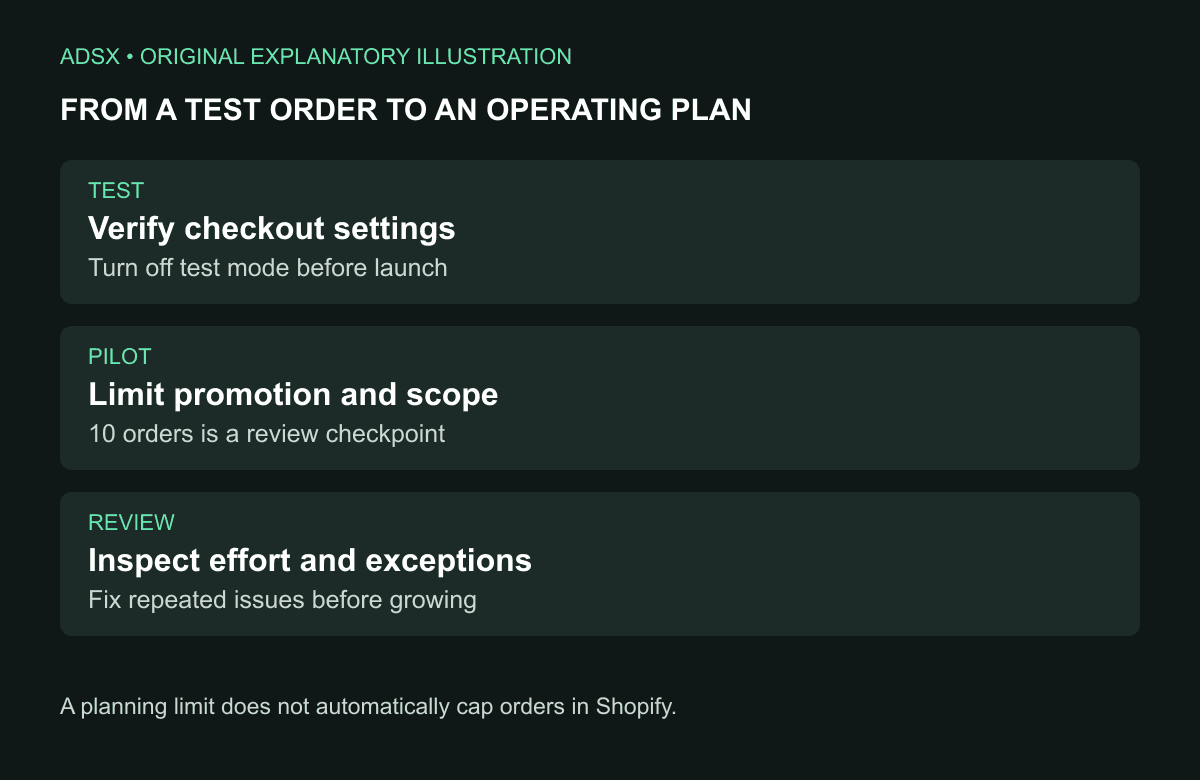
Original AdsX operating-plan illustration.
Complete the test phase before taking real orders
Follow the test-order checklist first. Shopify's launch preparation instructions require selecting a subscription plan, adding the store address, and setting up payments with test mode deactivated before launch. Review the plan terms shown for your account; do not infer an offer or a charge date from an older screenshot.
Check that the products you intend to sell are available, delivery settings match the addresses you will serve, and customers can find your policies and contact method. Test data and simulated payment success do not establish that a real payment was captured or that money has reached your bank.
For the full account-to-store sequence, start with Start a Shopify Store. This article begins where that setup work turns into actual order handling.
Choose a pilot you can fulfill
For a hypothetical handmade-accessory shop, the first pilot might use two stocked products, one shipping destination country, and no customization. That scope gives the merchant fewer variables to investigate when a problem appears.
Suppose packing takes 12 minutes per order and there are three hours available for the first dispatch session. Ten orders require 120 minutes, leaving 60 minutes for exceptions. If actual packing takes 18 minutes, ten orders consume the entire session. The review should change the plan before the merchant invites more traffic.
An order limit in your plan does not automatically stop Shopify checkout at ten orders. Control promotion volume and available inventory, monitor incoming orders, and decide in advance how you will stop inviting additional demand. Do not promise an automated order cap you have not implemented and tested.
Keep an operational log, not a customer-data dump
Use internal order references and access-controlled store records. There is no need to copy names, addresses, or payment details into an AI chat or a shared planning document.
| Check for each pilot order | Evidence to record |
|---|---|
| Payment | Actual order payment status and any review required |
| Product | Correct SKU, quantity, and any permitted options |
| Delivery promise | Dispatch deadline and whether the address is supported |
| Fulfillment | Who owns the next step and when it was completed |
| Customer communication | Confirmation and relevant delivery information available |
| Exception | Problem, resolution owner, and whether another order could repeat it |
Shopify's order management documentation distinguishes payment capture from fulfillment. A merchant should inspect both rather than treating a new order notification as a completed sale and dispatch.
Decide what would stop the next invitation
Set pause conditions before looking at the results. Examples include an incorrect shipping charge on a supported address, missing product information needed to fulfill, or a repeatable inventory mismatch. Investigate and retest the affected flow before expanding promotion. Continue to meet obligations to customers who have already ordered.
A single question about a product detail may call for a clearer product page. Two orders with the same missing option may indicate a broken workflow. The useful distinction is whether another buyer is likely to encounter the issue and how serious the consequence is; a ten-order percentage alone will not answer that.
Review contribution and effort together
For illustration, an order with $30 product revenue, $10 product cost, $6 seller-funded delivery, $1 packaging, and $1.20 payment fees leaves $11.80 before labor, advertising, returns, tax obligations, and fixed store costs. At ten identical orders that is $118 before those excluded costs—not $300 profit. These are assumptions, not Shopify fee quotes.
Compare the observed packing time, support work, and delivery cost with your plan. Use the startup cost calculator for the wider budget, and the first-store shipping budget guide if delivery is consuming the margin.
You can ask AI to summarize a redacted exception log, but this prompt is untested:
Group these anonymous pilot-order issues by likely repeated workflow.
Separate observed facts from hypotheses. For each group, suggest one
verification step and a responsible role. Do not infer customer demand,
profitability, payment settlement, or a software bug without evidence.
[Insert issue descriptions without customer or payment details.]
Expand the pilot only when the next batch fits your capacity and the repeated issues have an owner or a verified fix. A soft launch earns you a better operating plan; it does not guarantee demand or a profitable store.