The Shopify Agentic plan lets a business explore Shopify’s AI selling channels while keeping its existing ecommerce platform. Moving the storefront itself is a separate decision. Upgrade when you have a reason to operate the store on Shopify and a workable transition plan, rather than treating AI distribution as an automatic commitment to migrate.
This guide is for an existing merchant deciding what to move next. Public documentation was reviewed October 15, 2026. The business and numbers below are illustrative planning examples, not results from a migration we performed.
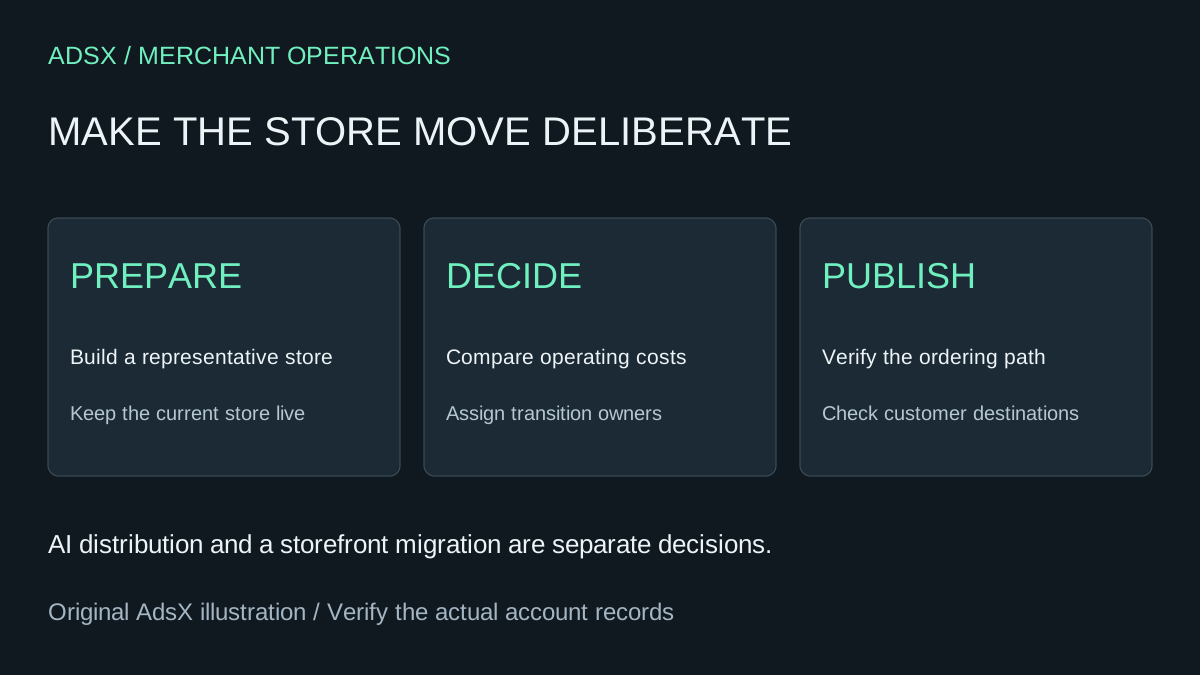
Original AdsX explanatory illustration.
What changes when you publish a Shopify store?
Shopify’s Agentic plan documentation describes a plan for merchants using another ecommerce platform. It has no monthly subscription fee, although payment processing, paid apps, and other services can still incur charges. Availability in an AI channel depends on eligibility; it does not guarantee a product placement.
The online-store access guide distinguishes preparation from publication. You can build the store on the Agentic plan, but it stays password protected and its online-store checkout cannot accept purchases. Publishing requires a paid Shopify subscription. Agentic storefront product links continue pointing to the existing store until the Shopify online store is published after the plan change.
That gives you room to investigate a migration before changing the customer journey. It does not mean that a finished theme proves the business is ready to move.
Decide which problem a migration would solve
Imagine a small homeware seller whose current store takes orders reliably. Its staff spend several hours each week reconciling inventory and copying product details between tools. The owner is considering Shopify because those tasks are becoming difficult to manage.
Write the decision in operational terms: “Can the proposed setup reduce manual inventory work without breaking our delivery process?” That question can be checked. “We should be on the newest platform” cannot.
| Current situation | Sensible next step | Evidence needed before moving |
|---|---|---|
| Store works well; interest is mainly AI discovery | Evaluate the Agentic setup separately | Eligible products and a usable purchase path |
| Store is difficult to operate | Build a representative Shopify workflow | Product, order, inventory, and support handoffs |
| Replatforming is already planned | Treat Agentic work as one part of the migration | Cutover owner, URL plan, and order continuity |
| Team cannot explain the intended improvement | Pause the migration decision | A specific problem and acceptance criteria |
This is an editorial decision framework, not a Shopify eligibility checklist. A merchant may reasonably keep the existing storefront if the migration would consume time without solving an important problem.
Budget for the transition, including overlapping systems
The homeware seller estimates $80 a month for the current platform and $120 a month for a proposed combination of subscriptions and tools. Those are invented budgeting inputs, not Shopify prices. The proposed recurring difference is $40 a month.
If the move also requires 18 hours of work valued internally at $35 an hour, the planning cost is another $630. Keeping the old platform active for two overlapping months adds $160. That produces a first-year comparison of $480 in additional recurring costs plus $790 in transition costs: $1,270 before other changes.
The point is to expose assumptions. If the proposed workflow saves four hours a month at the same internal valuation, that is $140 of estimated monthly time value. It is not cash savings unless the business actually reduces spending or uses the time productively. Replace every input with your own quote, effort estimate, and operating needs. Our startup-cost calculator can help organize the recurring and one-time categories.
Prepare a small but representative store
Shopify says products, store settings, and the agentic setup carry over when changing plans. Its online-store guide also describes shared products, store details, and policies. Carryover should still be followed by a merchant review: an imported description can be technically present and commercially wrong.
Choose a small set that exposes real complexity: one ordinary item, one item with variants, and one with an unusual shipping requirement. Write down the expected price, stock behavior, delivery promise, and support route for each. Build the navigation around how a customer chooses between them.
Then assign a person to each unresolved question. Who maintains inventory during the transition? Where do earlier orders remain accessible? Who answers a buyer asking about an order placed on the old system? These are operating decisions, not theme settings.
Make publication a deliberate handoff
Keep a dated cutover checklist with the old and proposed destinations, the owner of each change, and evidence that the new ordering flow works. Use our test-order checklist for ordering readiness and private-mode guide for public access checks.
Before changing domains or retiring old pages, inventory important URLs and define where visitors should land. Do not assume that selecting a paid plan creates redirects, transfers historical orders, or completes every integration. Verify those tasks for the systems you actually use.
For the homeware seller, a reasonable launch condition is: representative products are correct, the inventory owner understands the new process, ordering checks pass, and older customers can still get help. After publication, inspect the customer-facing links again and keep a short issue log. Judge the move against the original operating problem, as well as sales.
Affiliate disclosure: AdsX may earn a commission from qualifying Shopify referrals. If you are evaluating a new Shopify account, review the current signup offer. Existing Agentic merchants should manage their plan in their own admin; this article does not promise that an upgrade qualifies as an AdsX referral.