Shopify Ventures’ participation in Whop’s new funding round is a reason to look at Whop, not a requirement to leave Shopify. The right decision still depends on what your store sells, how it delivers orders, and which workflows you would need to replace.
Whop’s October 21 announcement describes a $200 million Series D at a $5.1 billion valuation, led by Sequoia and Shopify Ventures. It is a financing announcement, not a notice that the two platforms are merging or that Shopify merchants are being transferred.
Disclosure: Dennis Hegstad works at Whop. AdsX may earn compensation from qualifying Whop referrals. Sources reviewed October 24, 2026. Examples are illustrative; AdsX has not performed these merchant migrations.
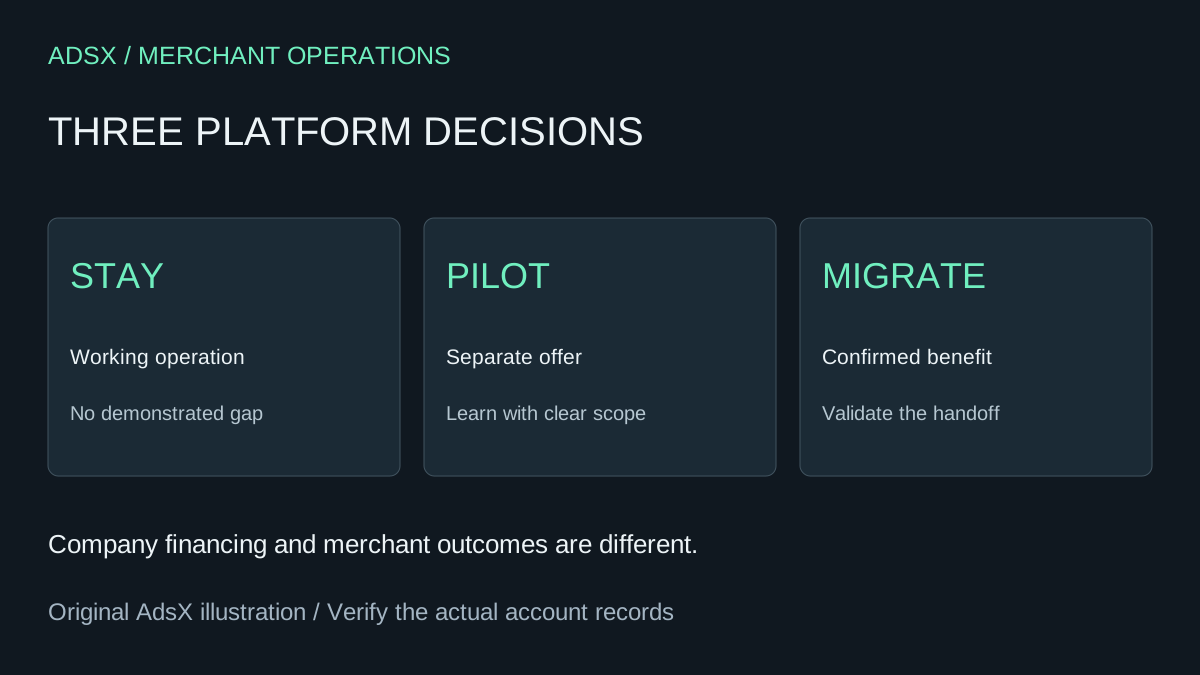
Original AdsX explanatory illustration.
Separate three different decisions
You can follow a company’s progress without changing your business. You can also evaluate a new offer on another platform without moving an established catalog. A full migration is the third option, and it needs its own business case.
| Path | A sensible reason | What to verify |
|---|---|---|
| Stay on Shopify | The current operation meets your needs | Whether the proposed change solves a real problem |
| Evaluate a separate offer | A new service or product needs a different workflow | Ownership of customers, delivery, and reporting |
| Migrate the store | A confirmed operational benefit justifies the move | Catalog, payments, integrations, URLs, and launch readiness |
This is our decision framework. It is not an investor recommendation or a claim that either platform is best for every merchant.
Start with one expensive piece of work
Suppose a merchant spends five hours a week reconciling orders between tools. A promising demonstration would show how the proposed system reduces that task without losing information. A new homepage alone would not prove the benefit.
Another merchant may be launching a coaching service alongside a physical catalog. Testing the service separately could answer questions about checkout and delivery before the merchant decides whether to move the rest of the store. Keep the responsibilities clear: which system takes payment, which delivers the service, and which handles a customer’s refund request?
Read the Whop versus Shopify comparison for broader platform questions. Use the funding news as context, then return to the requirements of your own business.
Keep a record before making changes
Shopify’s product export documentation supports exporting product data to CSV. It also notes that the image files themselves are not included. A data export is useful evidence for a migration review; it is not proof that every part of a store has been backed up or transferred.
Create a record of the products and workflows that matter most. Include a high-volume item, an unusual variant, an active promotion, and a purchase that needs special handling. Ask the proposed destination to demonstrate those cases rather than accepting a generic feature list.
Decide what would make you stop
Before an evaluation, write down the conditions that would prevent launch. Examples include an unresolved subscription transfer, a warehouse integration without an agreed replacement, or a checkout that presents the wrong price. These are observable conditions, not vague worries.
Also write down what would justify proceeding. For example: the critical product paths work, payment readiness is confirmed, the person responsible for fulfillment can operate the new flow, and the expected savings exceed the transition effort. The values belong to your business; the funding round does not supply them.
Our Shopify-to-Whop migration guide turns this decision into a store-specific plan. If you want to assess Whop for a concrete offer, sign up through AdsX’s Whop partner link. Keep the established operation available until the replacement meets your acceptance criteria.