Transferring Shopify ownership does not automatically resolve every domain, app subscription, payment detail, and customer obligation connected to the business. Prepare a handoff inventory before the authorized owner starts the transfer.
This is an operational preparation guide based on public documentation reviewed October 19, 2026. It does not perform a transfer, value a business, or replace the agreements governing a sale. The example is fictional.
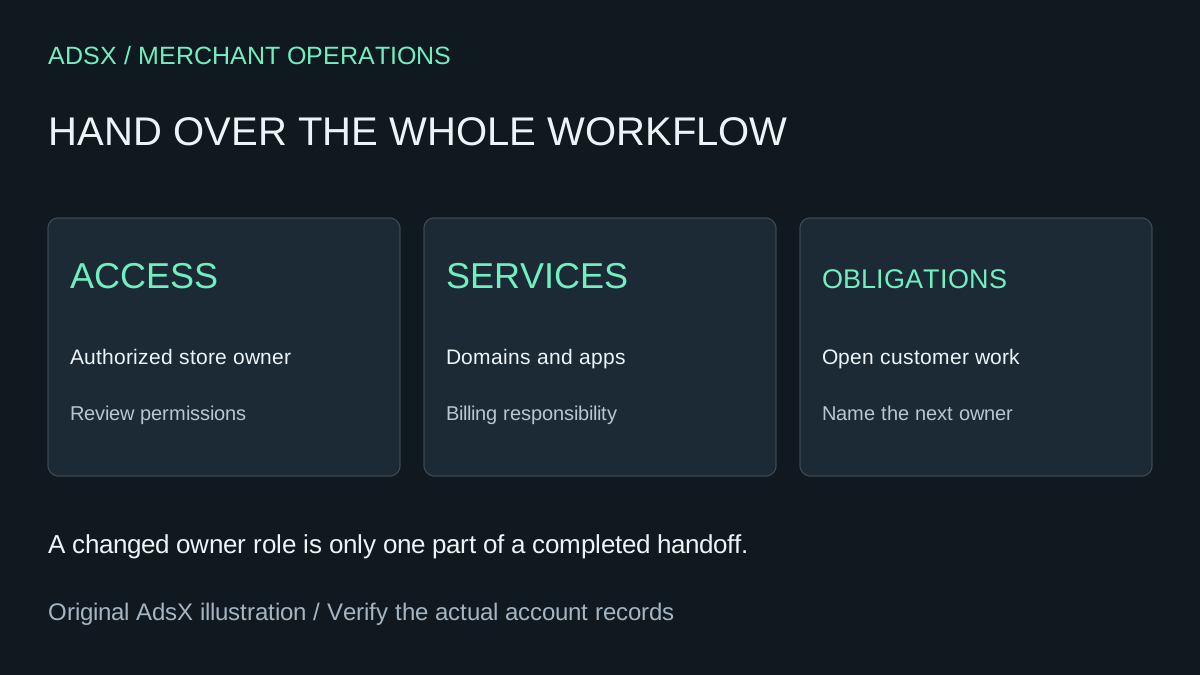
Original AdsX explanatory illustration.
Identify the transfer you are preparing
Shopify's ownership guidance distinguishes changing ownership to an existing user from transferring to someone outside the store. Only the store owner can change or transfer ownership. Shopify Plus has separate organization considerations and support paths.
Start by identifying the current owner, intended recipient, store, and organization context. Do not substitute a shared login for a supported ownership change. Each person should use their own authorized access and complete required verification themselves.
Agree on the handoff's scope before choosing a date. Does it include the brand domain, source files, supplier relationships, apps, and historical records? A Shopify store and the wider operating business are related, but the transfer button is not a complete inventory of either.
Build a responsibility register
For a fictional homewares store, the register might look like this:
| Area | Evidence to gather | Completion question |
|---|---|---|
| Shopify ownership | Correct store and recipient | Does the intended person hold the owner role? |
| Domain | Registrar and authorized owner | Can the new owner manage renewal and DNS? |
| Apps and external services | Provider, billing owner, essential function | Is continued access and billing responsibility clear? |
| Customer obligations | Open orders, returns, and support cases | Who handles each outstanding item? |
| Fulfillment | Warehouse contacts and current instructions | Does the operating team know the handoff date? |
| Records | Agreed retention and access requirements | Are necessary records available to the right party? |
Treat the register as a controlled business record. It should identify where credentials are managed without listing passwords or recovery codes. The recipient needs appropriate access, not copies of somebody else's personal authentication secrets.
Reconcile bills before the handoff date
Shopify's billing-history guidance distinguishes current-cycle charges from past bills. The current view includes the running total and charge breakdown; past bills include payment status and a payment timeline.
Use both views. A paid invoice from last month does not prove there are no charges accumulating now. List services billed outside Shopify separately, and agree who is responsible for amounts spanning the transition date.
The ownership guide says outstanding amounts below the billing threshold can become the new owner's responsibility. It also flags financing and financial-product restrictions, including Shopify Capital and Credit, and directs merchants to support for some payment-business-information changes. Resolve applicable restrictions through the official process before scheduling the transfer.
Our app-cost audit can help inventory subscriptions. Do not cancel a critical fulfillment or customer-service app simply because the current owner wants a clean final bill; first establish how its work will continue.
Transfer the domain as its own workstream
Shopify specifically calls out transferring a custom domain to the new owner. Record its registrar, renewal timing, and who controls DNS. Verify the appropriate process for that domain rather than assuming a store-role change also changes registrar ownership.
A useful acceptance check is practical: can the authorized recipient manage the domain and keep the website working? Keep email and other DNS-dependent services in the review. Our domain connection checklist explains why web and mail records deserve separate attention.
Do not replace working DNS records merely to make the handoff look complete. Ownership, billing contact, and traffic routing can be separate settings. Change only what the agreed transfer requires and verify the result.
Carry open customer work across the boundary
Choose a cutoff timestamp for the operational snapshot. Include unfulfilled orders, unresolved returns, refunds in progress, and promises made by support. Record the next action and owner for each exception.
For example, a customer whose replacement parcel is due tomorrow should not become “the previous owner's problem” simply because the administrative transfer happened today. Agree on the handoff before a gap appears. The same applies to a supplier shipment arriving after the transition.
Verify completion without closing access too early
After the authorized parties complete the official transfer, verify owner identity, necessary staff permissions, essential integrations, billing responsibility, and a normal customer journey. Shopify notes that organization-related permission changes can require review.
Retire obsolete access through the agreed process after the new owner can operate the business. Keep a record of unresolved items with deadlines rather than declaring the entire transition finished because one role changed.
The strongest handoff is one where both parties can explain who controls each critical system and who handles the next ordinary customer request.