Examples and worksheets are original editorial planning aids, not observed merchant results. Sources checked November 28, 2026.
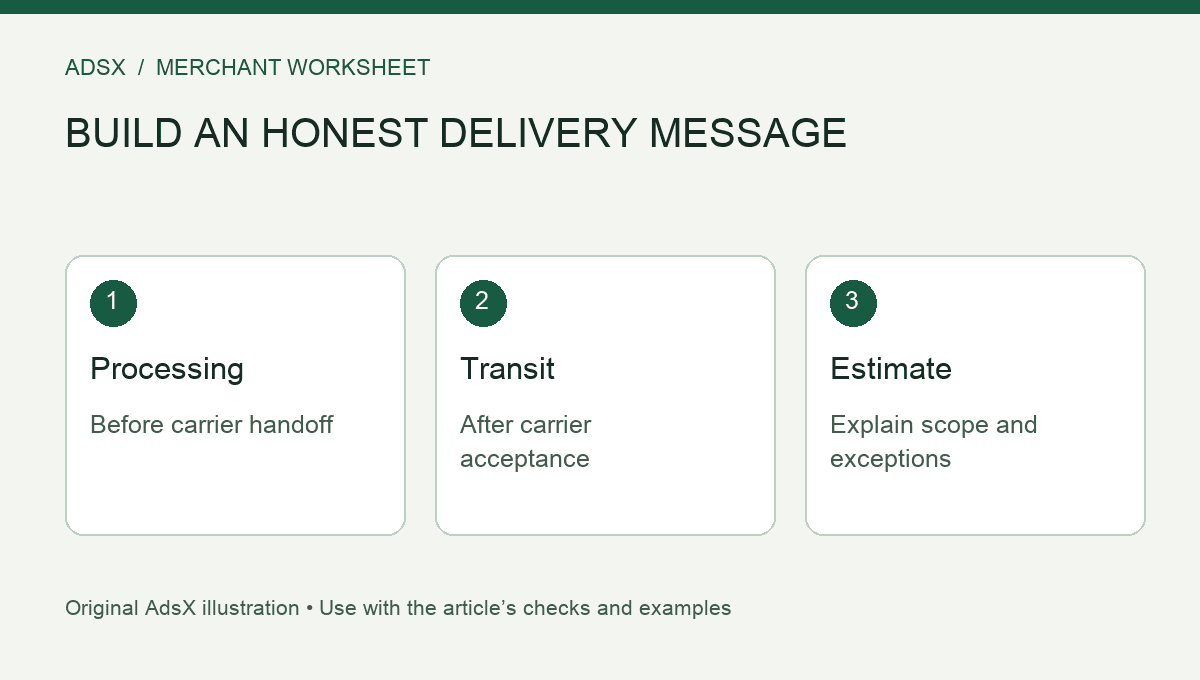
Original AdsX explanatory illustration.
“Ships in two days” and “arrives in two days” make different promises. Before launching a Shopify store, separate the time you need to prepare an order from the carrier's transit estimate. Then make the same distinction everywhere the buyer sees delivery information.
AI can compare wording for contradictions. It cannot establish a carrier's current service performance or guarantee an arrival date from a product description.
Write the underlying operating facts
For an illustrative shop, assume packing happens Monday through Friday and takes one to two business days after order review. A selected carrier service has an estimated three-to-five-business-day transit window. Those assumptions suggest roughly four to seven business days across the two stages, but they are not a verified delivery guarantee and do not account for every cutoff or holiday.
Shopify's shipping rate guidance distinguishes transit estimates from processing time. Its transit-time documentation describes settings for flat rates. Check the options available to your store and the actual service rather than copying the example above.
Compare the customer-facing statements
Collect the relevant text from the product page, shipping page, cart message, checkout delivery option, and order email. Keep the text with its location so someone can fix the right surface.
| Surface | Example problem | Review action |
|---|---|---|
| Product page | “Delivered in two days” | Check whether two days only means processing |
| Shipping page | Business days not defined | State the actual operating calendar |
| Order email | Says dispatched immediately | Match the message to the real event |
| Checkout | Service estimate differs | Inspect the rate and delivery configuration |
Do not change a carrier-generated estimate simply to make the wording agree. Resolve the underlying configuration or explain the stages accurately.
Use AI to identify contradictions
This prompt is untested:
Compare these delivery statements against the supplied operating facts.
Flag contradictions, undefined business days, missing cutoff context,
and claims that confuse dispatch with arrival. Suggest plain wording
only where facts are supplied. Do not invent carrier guarantees,
weekend service, holiday schedules, or delivery dates.
[Paste approved operating facts and labeled storefront excerpts.]
A useful response should leave unresolved questions visible. Have an operator verify the proposed wording, including how exceptions are communicated. This is a text review, not a Flow workflow, Sidekick action, or delivery-date app.
Check the real buying path
After editing, inspect one representative product and destination from product page through checkout and the order notification test. Include a product with a different preparation time if you sell one. A single generic promise can be misleading when stocked and made-to-order products share a cart.
Keep a record of the reviewed text and date. Recheck it when fulfillment capacity, carrier service, or the launch territory changes. The first-market decision guide helps decide which destinations you can support initially.
Use Start a Shopify Store for the wider setup. Clear expectations will not eliminate delays, but they give customers and support staff the same understandable plan.