A review summary is useful when it helps a merchant decide what to investigate. It becomes misleading when a model turns a few comments into a universal customer preference, changes the meaning of a quote or presents generated wording as a customer testimonial.
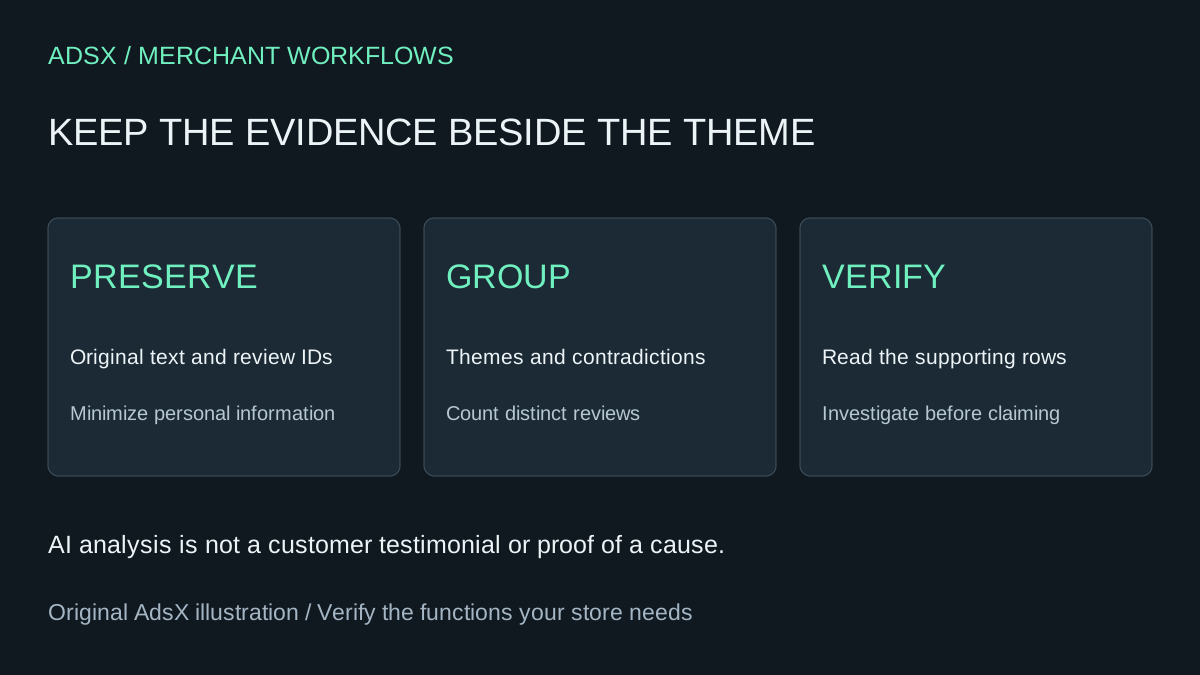
Original AdsX illustration.
This workflow uses a sanitized product-review export for internal analysis. It does not generate reviews, moderate customer feedback or replace the app that collects and displays it. The sample and prompt are original illustrations, not findings from an AdsX merchant account.
Export a defined slice of evidence
Start with one product or a clearly defined product family and a stated interval. Record whether the input includes published, hidden or archived reviews. A summary of only five-star reviews answers a different question from a summary of the full available sample.
For a concrete source, Judge.me's export guide documents CSV export on its free plan, including product and date filtering. It limits a file to 100,000 reviews. Exports can contain reviewer names, emails and other personal information, so create a minimized analysis copy rather than uploading the raw file indiscriminately. Preserve a private reference to the original rows for verification.
Keep a review identifier, product identifier, rating, date and the text necessary for the task. Remove unnecessary contact details and redact identifying material within the text. Do not assume removing the name column anonymizes a review that mentions a specific person or address.
Keep the source and interpretation separate
A fictional travel-mug sample might contain these three observations:
| Review ID | Original observation | Possible theme |
|---|---|---|
| R01 | Lid was hard to open on the first day | Opening effort |
| R02 | Fits my car holder; wish it were easier to clean | Fit and cleaning |
| R03 | Easy to wash by hand | Cleaning, positive |
R02 contributes to two themes, so theme counts can exceed the number of reviews. R03 also prevents a one-sided claim that every customer finds cleaning difficult. The table is a synthetic example and must never be published as real customer feedback.
Give the assistant explicit rules for contradictory evidence and multi-theme comments:
Analyze this sanitized review table for internal product research.
Keep review IDs and original text unchanged in the evidence column.
Assign zero or more themes to each review; allow positive and negative evidence.
Report the number of distinct reviews supporting each theme and the total sample.
Do not add theme counts together as a unique-review total.
Keep unclear comments unclassified and show conflicting evidence.
Suggest questions to investigate, not proven causes or invented testimonials.
Do not change ratings, verification status, publication status or customer records.
Use only an approved tool and data you are authorized to process. An assistant can organize comments without needing access to your customer database or review-app credentials.
Review the labels against the actual rows
Read every row supporting the highest-priority themes in a small sample. For a larger set, define a review method and preserve traceability rather than relying on a polished paragraph. Check whether the model grouped distinct problems together, missed negation or confused shipping damage with product durability.
“Arrived late but works well” is not negative product-performance evidence. “Not too heavy” should not become a weight complaint. Sarcasm, translated text and mixed sentiment deserve particular attention. Ask for uncertain classifications instead of forcing every comment into a confident label.
Judge.me's reviews dashboard guide provides the source context for inspecting reviews, including linked orders where applicable. Verify important questions in the original system using appropriate access. A CSV's missing field is not permission to invent it, and an AI label does not establish verified-buyer status.
Turn the finding into a small decision
Suppose the mug comments raise a cleaning question. Possible next steps include checking whether the product page explains disassembly, whether the instructions match the actual product, and whether the lid design has a recurring issue. Review comments alone cannot determine which explanation is correct.
Choose an owner and the evidence needed before making a change. If a copy clarification is justified, use the product FAQ review checklist to keep the answer factual. Do not turn an internal theme into “customers love our easy-clean lid” without appropriate supporting evidence and context.
The purpose is better investigation, not suppressing inconvenient reviews. Keep publication and moderation decisions separate from theme analysis. Do not rewrite real customer wording and re-import it as if the customer supplied the revision.
Price the analysis function separately
This process might replace an occasional manual summary or a separate analysis add-on. It does not replace collection requests, review display, media hosting, moderation workflows or integrations. If the review app remains necessary, its subscription saving is zero.
For a hypothetical monthly task, cutting preparation from 90 to 45 minutes saves nine hours over twelve runs before additional QA. At $30 per hour that is $270 of staff capacity, not automatic cash savings. Measure actual preparation and review time; a difficult export or unreliable classification can erase the benefit.
Use the review-app selection scorecard for the broader purchase decision and the merchant prompt library for the brief. A defensible summary lets a colleague trace a conclusion to its source and disagree with it constructively.