A lower unit price can leave a new store with less room to operate. Before accepting a supplier quote, compare the total cash commitment with the quantity you can reasonably sell and the money you need to keep available.
This guide starts after you have evaluated samples. It answers which opening order to place, not whether a sample is good enough. If you have not checked quality and packaging, use the supplier sample guide first.
Disclosure: AdsX may earn a commission from qualifying Shopify referrals through signup links. The quotes and calculations below are original hypothetical examples, not supplier offers or observed sales. Documentation checked November 28, 2026.
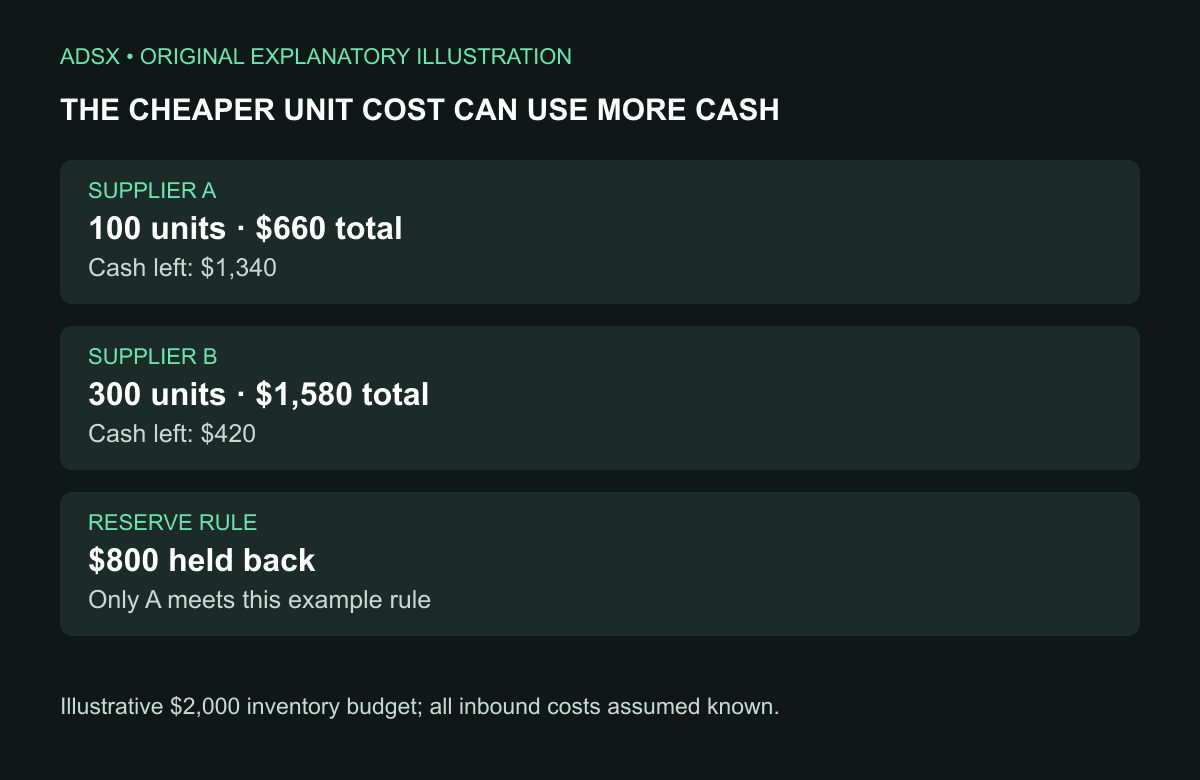
Original AdsX illustration. The reserve is a planning assumption, not a recommended universal amount.
Put both suppliers on the same basis
A minimum order quantity, or MOQ, is the supplier's smallest accepted order. Shopify's MOQ guide explains how that requirement affects purchasing and inventory. Ask whether the minimum applies per order, product, color, or size. “100 pieces” is not helpful if each of five colors has its own 100-piece minimum.
Ask both suppliers for the same specification, currency, quantity, packaging, delivery destination, and payment schedule. List anything excluded from the price. Shipping estimates, import charges, inspection, and local delivery should not quietly become zero because a quote omits them. Obtain applicable amounts from the supplier, carrier, or relevant specialist before committing.
For an illustrative small accessory, assume all quoted inbound costs are known:
| Opening order | Supplier A | Supplier B |
|---|---|---|
| Units | 100 | 300 |
| Price per unit | $5.00 | $4.00 |
| Goods subtotal | $500 | $1,200 |
| Inbound delivery | $120 | $300 |
| Setup and packaging charge | $40 | $80 |
| Total cash committed | $660 | $1,580 |
| Cost per received unit | $6.60 | $5.27, rounded |
B saves about $1.33 per received unit, but requires $920 more cash and three times the stock. The table assumes payment in full before delivery. A deposit would change payment timing, not erase the remaining obligation.
Test the reserve before celebrating the discount
Suppose the merchant allocates $2,000 to opening inventory and wants to retain $800 for problems and replenishment. A leaves $1,340; B leaves $420. Under that merchant's own reserve rule, B does not fit even though its unit economics look better.
Now assume 5% of received units are unusable. A has 95 sellable units and an effective inventory cost of $660 ÷ 95 = $6.95 each. B has 285 and costs $1,580 ÷ 285 = $5.54 each. B still wins on cost per usable unit. It still fails the reserve test. A sensitivity check should reveal tradeoffs, not manufacture a single winning score.
At an assumed 20 units sold per month, A represents five months of stock before defects and B represents fifteen. This is arithmetic, not a demand forecast. Replace the assumption with evidence and consider how product changes, seasonality, or storage limits affect that exposure. Shopify's inventory management overview provides background on maintaining stock levels.
Ask for a smaller commitment with clear terms
If B's product and quality are preferable, ask whether the supplier can quote a smaller first run, fewer variants, or a paid setup fee in exchange for a lower minimum. A blanket order with later releases can still create a binding commitment; do not describe it as a cheap trial without reviewing the terms.
Record four answers before deciding: what must be paid now, what remains owed, what happens if delivery is late, and how defects are handled. Keep the actual written quote alongside your comparison. A spreadsheet cannot resolve an unanswered supplier obligation.
Use AI to find missing inputs, not approve the purchase
The following prompt is untested. Use redacted figures; remove bank details, contact information, and confidential terms you are not permitted to share.
Compare these two opening-inventory quotes using only the inputs below.
Show goods cost, known inbound costs, cash due now, total commitment,
cost per received unit, and cash remaining from my stated budget.
Keep unknown charges marked unknown. Do not invent tax or duty rates.
Check whether each quote meets my reserve rule. List clarification
questions separately. Do not select a supplier or place an order.
[Insert redacted quotes, inventory budget, and reserve assumption.]
Recalculate the totals yourself and check the output against the documents. This is a review aid, not a tested purchasing system.
Once the order fits your budget, add platform, app, and operating costs with the Shopify startup cost calculator. Then follow Start a Shopify Store to turn the approved assortment into a store setup plan. Opening a store does not require buying the largest order your supplier will sell you.
If supplier documents disagree, use the AI-assisted specification conflict review before publishing product claims.