Order a supplier sample when it can change a buying decision. Suppose you plan to sell a travel pouch for $28 and promise that it fits a particular charger. A sample can tell you whether the charger fits with the zipper closed, whether the seams hold and what the packed pouch weighs. If the supplier’s minimum order already exceeds your cash budget, settle that question before spending $72 on a sample.
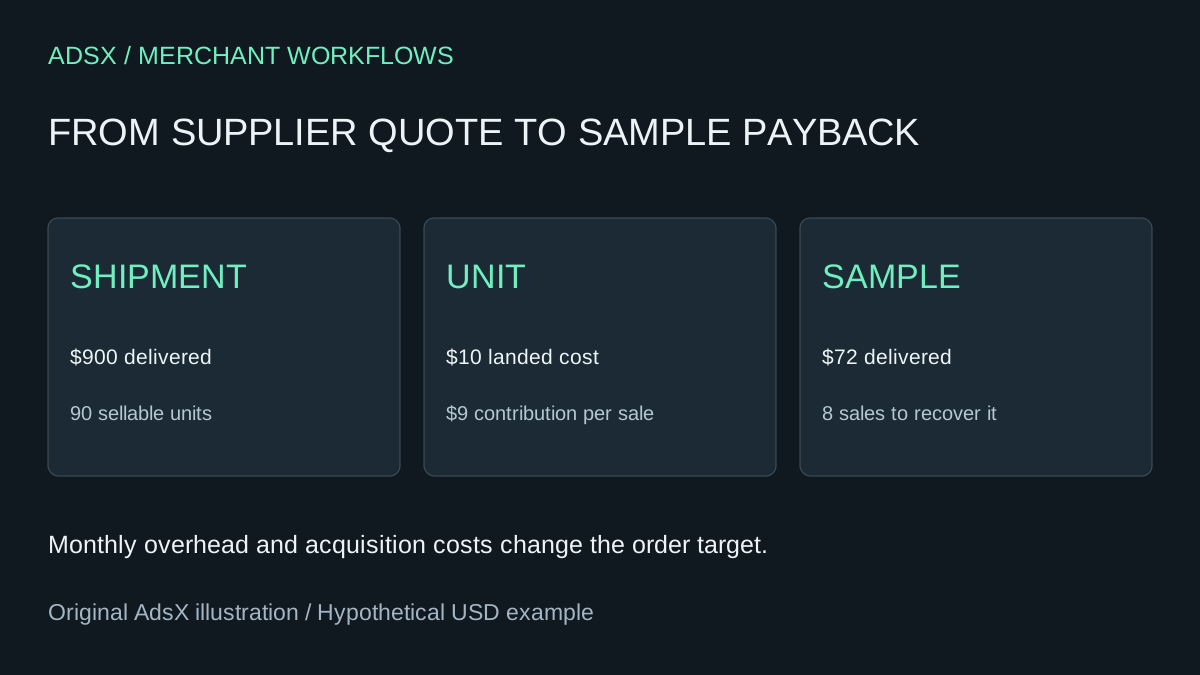
Original AdsX illustration. All figures below are hypothetical USD amounts.
Ask for two quotes before paying
Get one delivered price for the sample and another for the smallest production run you would actually buy. Ask the supplier to identify the material, dimensions, finish and packaging in both quotes. A stock pouch with a different zipper can answer a size question while leaving your most expensive quality question open.
You can send this short request: “Please quote one finished sample delivered to my postal code and 100 production units delivered to the same location. List what each price includes, the packed dimensions and weight, lead time, and what happens if the production run differs from the approved sample. Is the sample charge credited against the first order? If so, please show the credit on the quote.”
Keep the approved sample and dated specifications for comparison when the stock arrives. Shopify’s wholesale buying guide covers supplier verification and terms for defective or incomplete shipments.
Turn the bulk quote into a cost per sellable unit
In this example the supplier quotes $7 per pouch. That price covers only the first line below. Use the same delivery destination when comparing quotes and check who pays each charge. The International Trade Administration’s landed-cost guide explains what to include. Use your actual freight and import estimates.
| Production shipment to your receiving location | Example cost |
|---|---|
| 100 pouches × $7 | $700 |
| Inbound freight and insurance | $140 |
| Assumed import and handling charges | $60 |
| Total delivered shipment | $900 |
If all 100 pouches are sellable, each costs $9 delivered. If ten units are unusable with no supplier reimbursement, the same $900 buys 90 sellable pouches at $10 each. Ten unusable units are a downside scenario, not a defect rate inferred from one sample. The separate $72 sample is a one-time expense in this example. If the supplier later credits it, apply the credit once.
How many orders cover the sample?
Assume one pouch per order, a $28 selling price, no discount and free shipping for the buyer. Use the downside unit cost of $10. Allow $5 for outbound postage, $2 for packing and fulfillment, $1 for payment fees and $1 for expected post-sale returns or replacements. Those are example costs, including an assumed fee rather than a Shopify rate quote.
$28 − $10 − $5 − $2 − $1 − $1 = $9 contribution per order. The inbound freight is already in the $10 unit cost. Outbound postage pays for the second journey, from your stockroom to the customer.
| Decision | Calculation | Result |
|---|---|---|
| Recover the sample alone | $72 ÷ $9 | 8 orders |
| Cover $180 of recurring monthly costs | $180 ÷ $9 | 20 orders per month |
| Cover both in month one | ($180 + $72) ÷ $9 | 28 orders |
If each order also costs $6 to acquire, contribution falls to $3. It would take 84 orders to cover the same $252 in month one, nearly the entire sellable lot. At acquisition costs of $9 or more, these orders contribute nothing toward the sample or monthly overhead. Revisit price, costs or the offer before committing to the production order.
Make the sample earn its place
Put the advertised charger in the pouch and zip it. Inspect the stitching and measure the packed sample against the shipping quote. Record pass, fail or unresolved beside each claim you intend to put on the product page. If the fit fails, request a revised sample or drop the claim. If the sample passes but the economics require 84 orders, validate demand at the actual selling price before buying the lot. The trending products guide walks through that offer test.
Run your figures through the Shopify startup cost calculator. For this example, enter $900 as initial inventory, $72 as a one-time expense, $180 as monthly fixed costs and $10 as product cost per order. Put postage, fulfillment and payment fees in their corresponding per-order fields. The calculator shows opening cash and monthly break-even. Use the separate sample-payback calculation above for the eight-order question.