Choose annual billing when you have a credible reason to operate for the full term and can fund the upfront charge without squeezing the launch. Choose monthly billing when the shorter commitment is worth more to you than the potential annual saving. Neither option proves that the store will attract customers.
The key question is not just which price looks smaller. It is how much cash you commit now, and what happens if the launch changes direction. This guide compares billing cycles for the same plan; use our Shopify plan comparison to decide which features you need.
Disclosure: AdsX may earn a commission from qualifying Shopify signup links. All figures below are hypothetical planning inputs, not current Shopify prices or observed merchant results. Official documentation reviewed November 28, 2026.
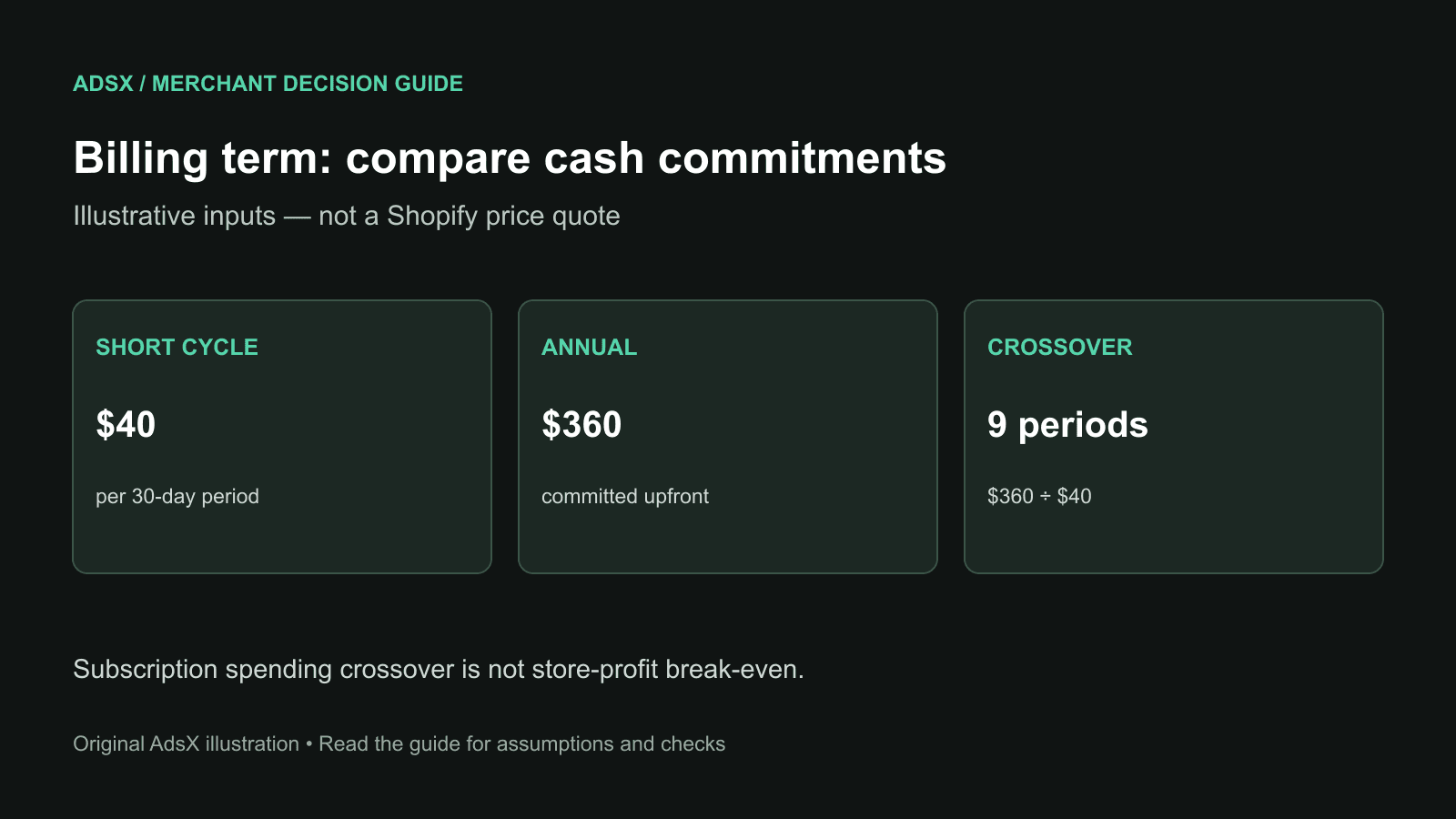
Original AdsX billing-decision illustration. Replace the assumptions with your account quote.
Compare the amount charged, not the advertised equivalent
Shopify's billing-cycle documentation distinguishes a 30-day subscription cycle from annual billing. Annual billing collects the year's charge upfront; an effective monthly price is not a monthly installment. Other charges can still appear during an annual subscription.
Record these four values from your account before making a decision:
| Input | What to record |
|---|---|
| Short-cycle charge | The regular amount for each 30-day subscription period |
| Annual commitment | The full amount due for the annual term |
| Introductory offer | Its separate charge, eligibility and end date |
| Other cash needs | Inventory, shipping materials, apps and a working reserve |
Use one currency and a consistent treatment of taxes. If the quotes differ in included features or services, this is no longer a pure billing-cycle comparison. List those differences separately rather than treating them as a discount.
Work through a stop-early example
Assume a hypothetical quote of $40 per 30-day period or $360 upfront for a year. Ignore promotional offers, taxes and other charges for this illustration.
| Number of 30-day charges incurred | Short-cycle subscription spending | Annual charge already committed |
|---|---|---|
| 3 | $120 | $360 |
| 6 | $240 | $360 |
| 9 | $360 | $360 |
| 12 | $480 | $360 |
The arithmetic crossover is $360 ÷ $40 = nine billing periods. This is a comparison of subscription spending, not a store-profit break-even point. Twelve 30-day periods are 360 days, so use actual invoice dates when comparing a full calendar year.
If the merchant closes after three periods, the shorter-cycle example has incurred $240 less in subscription charges. If the merchant incurs twelve periods, the annual example costs $120 less. Neither outcome includes sales, product margins or the value of keeping cash available.
Do not assume the unused annual term will be refunded. Shopify's documentation describes subscription charges as generally non-refundable and says most annual-to-monthly changes take effect at the end of the current cycle. Account restrictions can affect the available options; review the effective date before confirming a change.
Check what the upfront charge displaces
Suppose the launch budget is $1,000. The hypothetical annual charge leaves $640 before inventory and other expenses; the first $40 charge leaves $960. That $320 difference is temporary cash availability, not a $320 saving. Future monthly bills still need funding.
Now add the launch commitments: $500 of stock, $90 of packaging and $150 reserved for operating exceptions. The annual choice leaves a $100 shortfall against those planned uses; the first short-cycle charge leaves $220. The merchant can change the stock purchase, add capital, delay launch or use a shorter billing commitment. A headline discount does not resolve the cash shortfall.
Enter your own assumptions in the Shopify startup cost calculator. Keep the annual payment on the cash timeline even if you divide it by twelve for an operating-cost estimate.
Keep the trial decision separate
Shopify's plan FAQ says selecting a monthly plan during the free trial does not start subscription charges until that trial expires. Check the offer and subsequent billing terms shown to your account; do not assume an introductory period changes the normal renewal commitment.
Use the trial evaluation scorecard to decide whether the platform fits. Then choose the billing term. A store that cannot yet explain its product, fulfillment method and launch budget has a readiness problem that annual billing will not fix.
When you are ready to set up the store, follow Start a Shopify Store. Save your billing quote and decision date with the launch budget so the next review compares actual charges with the assumptions you approved.