A $10 thank-you coupon costs nothing to issue today and can reduce margin on a future order. That timing makes a two-sided referral offer easy to misprice. Start with the friend’s first order, then model what happens when the original customer comes back.
Original AdsX illustration.
Follow the reward through fulfillment
Judge.me offers referrals on its Awesome plan. A one-way offer gives the friend a discount. The two-way configuration also rewards the original customer after the qualifying friend order uses the discount and is fulfilled. Inspect the order and discount usage when reconciling a reward. Someone opening the referral link is too early to count as an acquired customer. Judge.me referral setup · Judge.me plans
Compare the same hundred friend orders
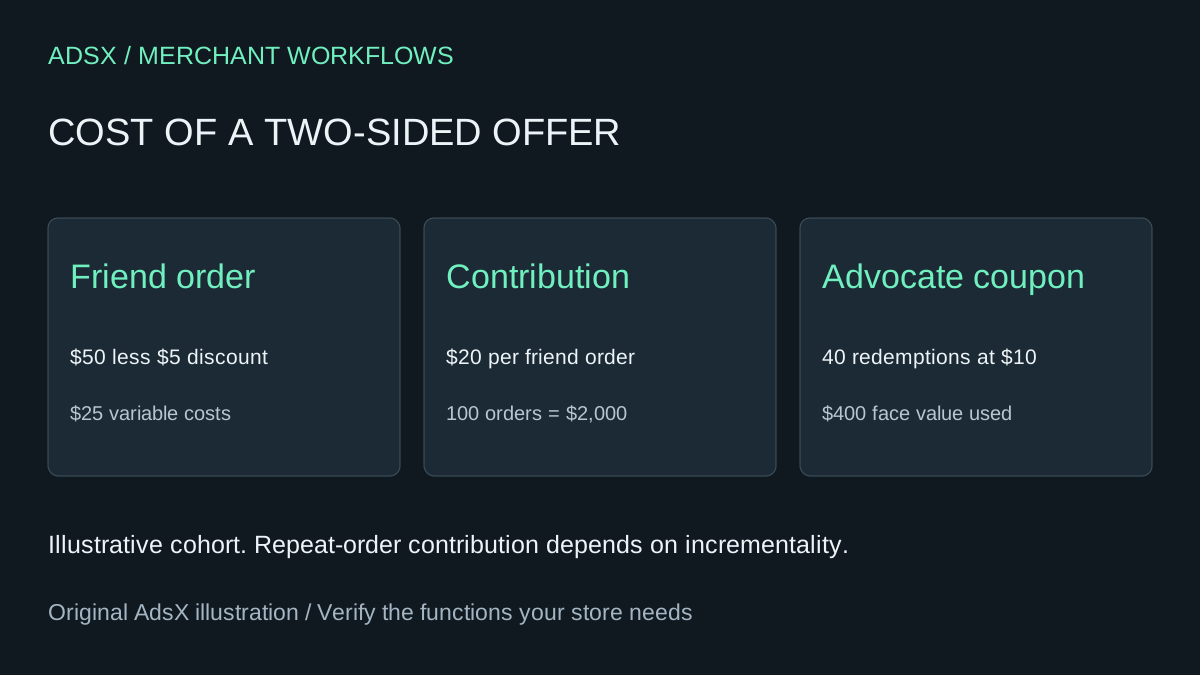
Assume 100 qualifying orders with a $50 basket, a $5 friend discount and $25 in variable costs per order, including goods, fulfillment and processing. The resulting contribution is $2,000 before fixed costs. Both offers incur the friend discount. The extra decision is whether the original customer also gets a $10 coupon.
If 40 customers redeem it on purchases they would have made anyway, the extra discount reduces contribution by $400. At $20 contribution per additional friend order, another 20 orders would cover that difference if they create no additional advocate redemptions. For a continuing offer with the same 40% redemption rate, allow $4 expected advocate cost per new friend order. The net contribution becomes $16, so the steady-state threshold is 25 additional friend orders. That is 125 total versus 100 on the one-way offer. These figures assume unchanged baskets, costs and refund rates.
Read the result after coupons have had time to mature
Track qualifying friend orders, fulfilled orders, advocate rewards issued, redemptions, refunds and contribution by cohort. Give both cohorts equal time to redeem. An advocate who places an otherwise incremental repeat order can contribute margin beyond the coupon expense. Without a credible baseline for repeat buying, show that upside separately. Include any incremental app subscription and staff time in the final decision.
Prefer the one-way offer when the friend incentive already brings buyers and little extra participation follows the advocate incentive. A two-way offer earns its budget when additional contribution from friend and repeat orders exceeds its cost. This exercise estimates a merchant’s own program economics.
Try the worksheet prompt
Illustrative prompt, not execution-tested.
Compare one-way and two-way offers using these fictional basket, variable cost, friend discount, advocate discount and redemption inputs. Show incremental contribution per additional order and the break-even order count. Flag refund lag, fixed costs and repeat orders that might have happened anyway.
Copy the prompt from the merchant library. For related work, see Before You Switch Review Apps, Audit Your Judge.me Export.