An Amazon business can evaluate a Whop storefront without treating the move as an immediate replacement for its marketplace operation. The first decision is what the direct store will sell and how those orders will be fulfilled.
Keep three pieces separate: the product offer, the checkout, and the delivery operation. A website launch only settles the first part if the other two have not been connected and verified.
Disclosure: Dennis Hegstad works at Whop. AdsX may earn compensation from qualifying Whop referrals. Sources reviewed October 27, 2026. Examples are illustrative; this is a planning guide, not a report of a migration we tested.
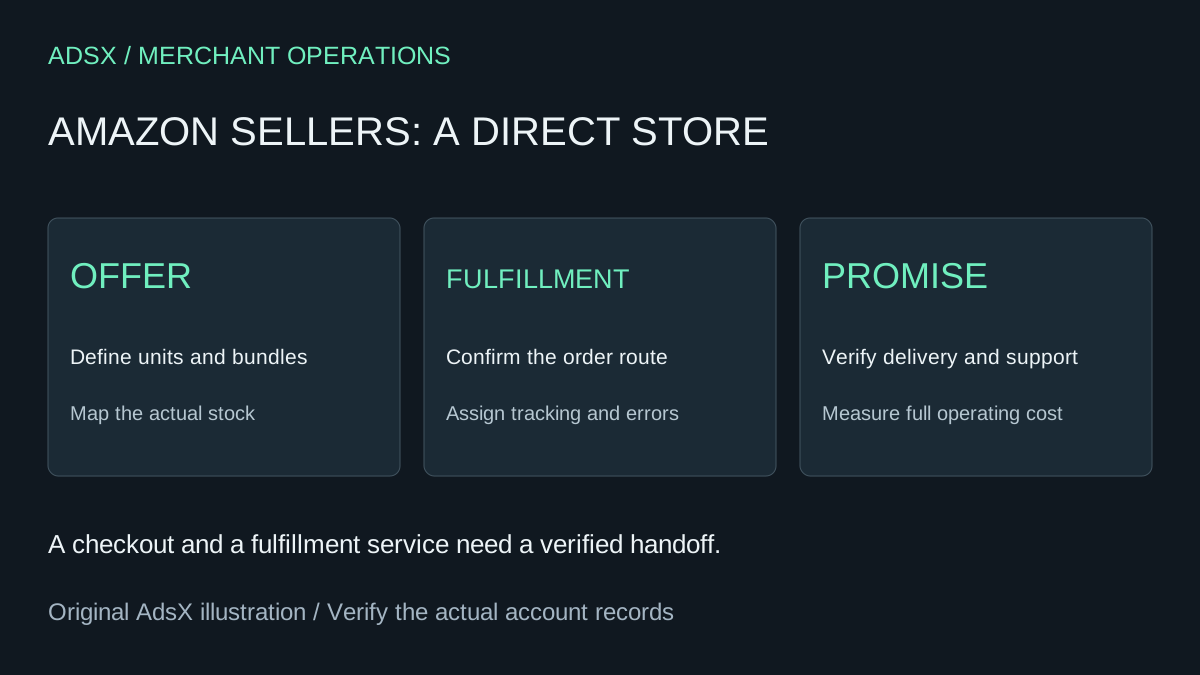
Original AdsX explanatory illustration.
Choose a direct-store assortment
Start with products for which you control the product information, media, supply, and customer support. Record the exact unit or bundle sold. A direct-store two-pack must not accidentally route to a fulfillment identifier representing one unit.
Build the new product page around what a buyer needs to know: contents, dimensions, compatibility, use instructions, and realistic delivery information. Do not imply that marketplace reviews, badges, customer accounts, or ranking transfer with the catalog.
| Decision | Record before launch | Acceptance check |
|---|---|---|
| Offer identity | SKU and units per order | The customer receives the advertised quantity |
| Fulfillment owner | In-house team or confirmed provider | An accepted order reaches the correct workflow |
| Availability | Source of sellable stock | The store does not promise unavailable units |
| Support | Return and inquiry owner | The buyer can get help for the direct purchase |
Understand the fulfillment distinction
Amazon's Multichannel Fulfillment overview distinguishes FBA orders placed in Amazon's store from MCF orders placed through other channels. MCF is one fulfillment option to evaluate for a direct website; it is not proof of a native Whop connection.
Confirm account eligibility, supported products and destinations, current charges, and the actual order-submission method before relying on it. If you use another fulfillment provider or your own warehouse, perform the same review for that setup.
A fulfillment service existing does not mean that orders from a new checkout automatically arrive there. Assign an owner to the connection, error handling, tracking updates, and reconciliation. Review the operational process before promising a launch date.
Example: a direct-store bundle
Suppose a brand wants to sell a cleaning kit containing two bottles and one cloth. Its current warehouse identifiers track bottles and cloths separately. The direct-store offer therefore needs an explicit mapping from one purchased kit to those three physical pieces.
Write down how the order becomes a picking instruction, who confirms shipment, and how a shortage is handled. Review a single-kit order and a two-kit order. The latter should produce four bottles and two cloths, not two total pieces.
This is an illustrative mapping exercise, not a tested integration. If a provider requires a prepacked bundle identifier, verify that requirement and prepare inventory accordingly. Do not invent bundle support from the appearance of a product page.
Set a direct-store delivery promise
Use the confirmed fulfillment workflow to determine what you tell customers. Do not carry over a marketplace delivery badge or promise by default. Check dispatch expectations, destination coverage, tracking, and the process for a lost or damaged shipment.
Keep the payment order ID and fulfillment reference linked in your records. Staff should be able to distinguish a direct purchase from an Amazon marketplace order when handling support or reconciliation.
Compare contribution after payment, fulfillment, storage where relevant, returns, and acquisition costs. Lower marketplace exposure alone is not proof that a direct channel is more profitable. Use actual charges and observed order behavior as the store develops.
Build the Whop site within a verified scope
Whop's website migration guide describes a URL-based site workflow. It does not establish that an Amazon listing or brand-store URL is a supported source, nor that private records or fulfillment settings transfer. Confirm source support and inspect the proposed site; use original product assets if a fresh build is more appropriate.
Follow the Whop migration checklist for domains, integrations, open obligations, and launch review. Build demand for the new store independently instead of assuming Amazon search visibility moves to it.
Test one offer before expanding
Keeping the marketplace channel active while evaluating a direct assortment can limit disruption. Expand only when stock, checkout, fulfillment, and support form a complete workflow that you can operate consistently.
Read the Whop launch checklist, then start a Whop account through our partner link. Use the pilot to learn whether the direct channel creates a useful buying experience and sustainable operating economics.