A timeout tells you that your application did not receive a usable response. It does not, by itself, prove that Whop did nothing. Before repeating a request with a new key, identify the operation you were trying to complete and the evidence you already have.
For a storefront integration, this can be the difference between recovering one checkout-creation attempt and creating a second resource while the first result remains unknown. The goal is to preserve the meaning of the operation across retries.
Disclosure: Dennis Hegstad works at Whop. AdsX may earn compensation from qualifying Whop referrals through our partner link. This guide uses public documentation reviewed October 21, 2026. Its timeline is hypothetical; no API writes, payments, or failure simulations were executed.
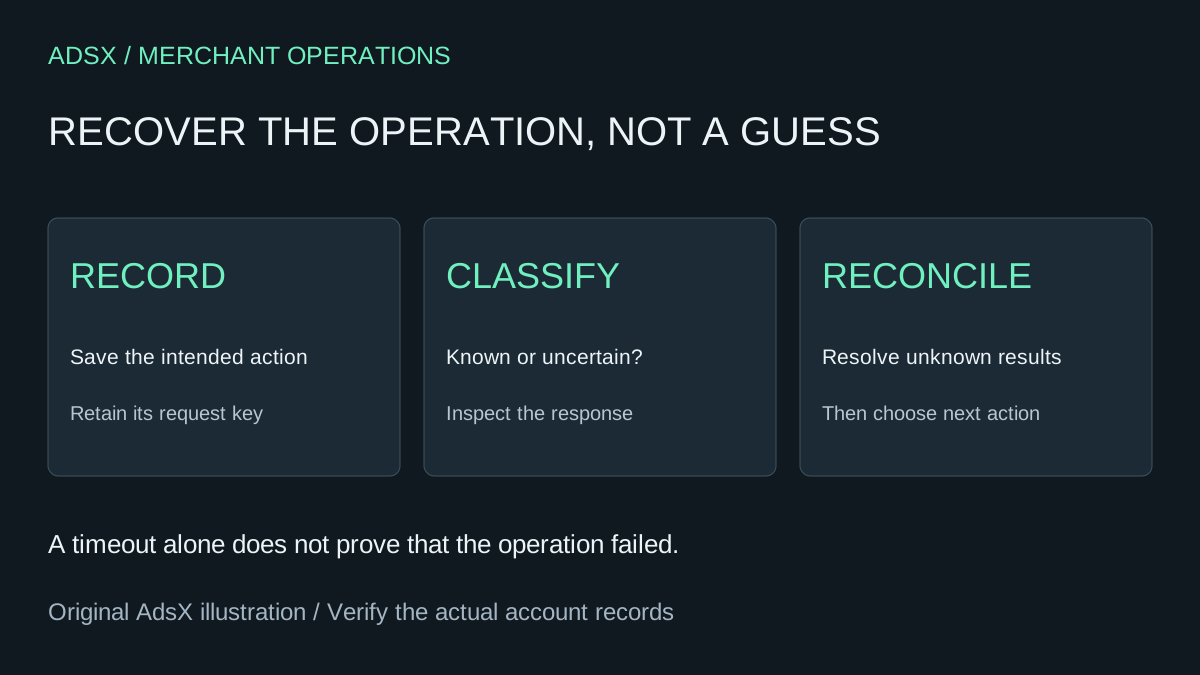
Original AdsX request-recovery illustration.
Understand the documented boundary
Whop's idempotency reference supports an Idempotency-Key on authenticated Current API POST requests. Stored responses last 24 hours. An exact retry uses the same key and request; a distinct operation needs a new key. Matching includes method, path, query, body, and API version, and keys are scoped to the authenticated caller.
That is a specific API mechanism, not a complete order-management system. Your application still needs to know which customer task prompted the request and whether its own downstream work has happened.
Read the versioning reference when recording the request version. Keep it explicit in the operation record. A dependency upgrade during recovery should not silently alter the request you are trying to repeat.
Save an operation record before sending
For a fictional checkout-creation flow, a compact internal record might contain:
| Field | Purpose |
|---|---|
| Internal operation ID | Identifies one intended business action |
| Idempotency key | Connects an exact retry to that attempt |
| Request fingerprint | Detects changed inputs before resending |
| Caller and API version reference | Keeps scope and version identifiable |
| First-attempt time | Supports retention-window decisions |
| Outcome and resource ID | Separates confirmed success from uncertainty |
| Recovery owner | Names who resolves an unresolved case |
Store the information securely. The record should reference credential configuration, not copy API secrets into general logs. Avoid logging unnecessary customer details or payment information.
Persist the record before sending the request. If you generate the key only in a worker's memory, a crash can remove the very value needed to identify the retry. Record a returned resource ID before triggering another job that depends on it.
Walk through an ambiguous attempt
Suppose the fictional storefront starts operation checkout-1042 at 10:00. It saves a key and its intended request, sends the request, and then loses the connection. Its state should remain “outcome unknown,” not “failed, create another checkout.”
At 10:01, the worker reloads the saved operation. It checks that the business still wants that exact action and that the request has not changed. Only then does it follow the documented retry procedure.
If the customer has changed the cart meanwhile, that is a different business decision. Do not overwrite the original record with the new cart and reuse its key. Resolve or account for the earlier attempt, then manage the changed purchase as a separately identified operation.
The Whop CLI storefront guide explains the broader product-to-checkout flow. This recovery record sits around that flow; it does not replace its payment and fulfillment checks.
Classify the response before choosing the next action
The idempotency documentation distinguishes a mismatched request (400) from an in-progress request (409). It also describes replayed errors and an unknown-outcome case that can keep returning 409 until expiry. An expired key can execute anew. Use those distinctions to decide whether to correct inputs, wait, or investigate.
Set bounded retries and an escalation path in your own application. A queue that retries forever can conceal a business task nobody is resolving. Give operators the sanitized request reference, timestamps, and observed response so they can investigate without reconstructing the incident from chat messages.
Do not interpret the retention window as a timer that authorizes another execution. If the original outcome is still uncertain near or after expiry, reconcile the actual resource and business state before initiating a new operation. Keep unresolved cases visible rather than marking them successful to clear the queue.
Keep API retries separate from fulfillment deduplication
Your application can successfully recover the API response and still perform its own next step twice. A worker restart or repeated event may cause duplicate internal jobs even when the original resource was created only once.
Define the business identifier for downstream work and record whether it has already been completed. For example, a recovered checkout configuration should not automatically imply a paid order or authorize shipment. Verify the relevant payment state through the supported integration before fulfillment.
When upgrading an existing integration, use the Whop migration checklist to review API and event behavior together. Keep the retry policy tied to the surface and version actually in use.
If you are evaluating Whop for a new business, start through the AdsX Whop partner link and plan a small, observable purchase workflow. A clear operation record makes the first integration easier to support when the network behaves imperfectly.